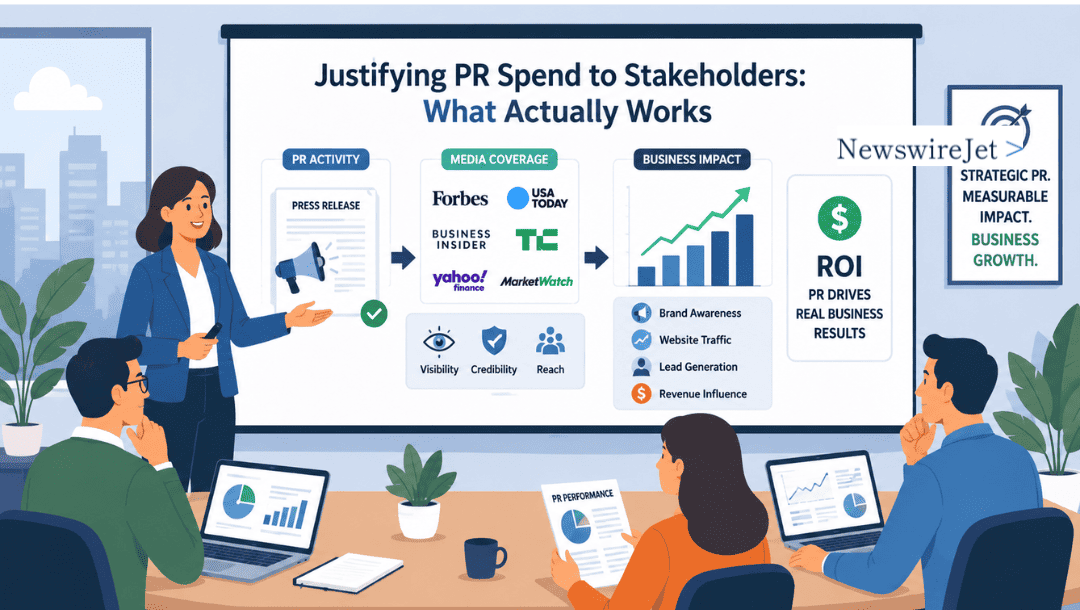
Today's finance teams demand proof your work drives real business outcomes, new revenue, lower risk, or stronger market trust.
If you can't connect your activity directly to those goals, the money likely goes elsewhere.
Your challenge is to change the language you use. Frame PR as a strategic engine for demand generation, a shield for reputation, and a builder of long-term customer value.
This guide explains how to make that shift, turning your next budget review from a defensive plea into a confident presentation. Let's get into it.
PR Budget Talking Points for Stakeholders
These points summarize how to clearly explain PR value and align communication efforts with business priorities.
- PR justification works best when communication activities connect to measurable outcomes and strategic priorities, which is why many teams start with clear PR budgeting frameworks that tie communication investment directly to business objectives.
- Position PR as business infrastructure that strengthens brand building and supports lower Customer Acquisition Cost over time.
- Use PR Performance data, marketing analytics, and visual aids such as iROAS charts to improve stakeholder alignment.
Why Stakeholders Evaluate Outcomes Instead of PR Activity
Executives sign checks for results, not tasks.
They look at the numbers: ROI, market share, profit. Deloitte says more than 70% of them focus on business outcomes, not what each department is doing.
According to Watson (2005),
"Unless I can prove its worth then it will be cut in tough times along with any other discretionary spend... the term 'PR ROI' should only be used when a ratio of how much profit or cost saving can be directly attributed to specific PR activities." - Bournemouth University Repository
This changes how people see marketing spending. A press release or a corporate event? It’s only worthwhile if it fits the broader strategy.
When budgets get discussed, three views usually come up.
- Finance folks worry about cost, risk, and what it all means for the company’s value later.
- Marketing teams judge everything, digital, performance ads, PR, by how it performs.
- Project managers and leadership want to know how communications support the organization’s priorities.
Showing PR activity without tying it to the sales pipeline or buyer understanding turns the talk into an expense. Using data turns it into an investment.
What a Press Release Actually Delivers to the Business

A press release shares your company's news. People trust it. It helps you get found on Google, and it gives your marketing team stuff they can actually use.
Getting covered in the news is better than buying an ad. Edelman did a study on this. They found that when a journalist writes about you, people believe it about twice as much as a sponsored post.
Why does this work for a business?
It's like getting a recommendation. If a reporter uses your facts, it tells customers, partners, and investors you're for real.
Once it's out there, the release sticks around online. It becomes a page that search engines can find, which helps your visibility.
And you don't use it just once. You can chop it up and use it everywhere.
That one press release turns into content for:
- The sales team's one-pagers
- Email campaigns and social posts
- Ads targeting people who visited your site
- Reports for investors and company updates
It keeps your message the same everywhere. Before we get into tracking numbers, let's look at how a clear budget plan usually lands with the people who hold the purse strings.
Breaking PR Spend Into Transparent Cost Components
We don't just ask for money. We show what each part buys and what it's for.
| Cost Category | What it's for | What you get |
| Strategy & Messaging | Plans how we talk about things to hit goals. | A one-page plan on what to say for a launch. |
| Writing & Editing | Make the final words for articles or posts. | The finished press release. A blog post. |
| Distribution | Put that content where people will see it. | Paying a service to send it out. Posting it online. |
| Media Outreach | Tries to get reporters to write about it. | Emailing journalists. Calling them. |
| Monitoring & Reporting | Check what happened after. | A list of who wrote about it. Some numbers. |
This shows the link between spending and doing. You can see a cost, and you can see the work it pays for.
Why each part matters:
- Strategy makes sure we're saying the right thing for the plan.
- Writing turns facts into something people want to read.
- Distribution is paying to get the story in front of more eyes.
- Monitoring is how we learn what worked, so we can do it again.
A budget like this is a map. It shows where the money is going and why. Many teams structure this planning around how they are allocating marketing budget across announcements, distribution, and media outreach so stakeholders can clearly see how each dollar supports communication impact.
What Metrics Demonstrate Press Release Impact

Everyone sends them out, but how do you know if yours did anything? You need to track three things: if people heard it, if they cared, and if it led to sales.
First, watch your website. After a good announcement that gets picked up, you should see a traffic bump. We're talking 20% to 40% more visitors, but only if those news stories actually link back to you. That data is useless unless you connect it to your customer system.
So, how do we measure it?
Awareness: Did They Notice?
Check how much of the industry chatter is about you versus your competitors. See who wrote about you, was it a major trade publication or a smaller blog? Get a rough idea of how many eyeballs saw it.
Engagement: Did They Click?
Look at the traffic coming directly from news sites. See how long those visitors stick around on your page. Count how many filled out a form for a demo or downloaded your guide. This tells you if the message was interesting enough to act on.
Pipeline: Did It Lead to Money?
This is the part that matters most. Your sales team has to mark down when a lead mentions they saw you in the news. Track those leads. Do they turn into customers? That's how you prove PR isn't just fluff, it's filling the funnel.
Don't use a simple "first-click" or "last-click" model. It's wrong. A customer might read an article, forget, then Google you a month later. We use a model that spreads credit across all the steps, so the press release gets acknowledged for its role.
The U.S. Small Business Administration says a clear plan makes measuring this easier, because you know what each piece is supposed to do. You can look up their advice on marketing planning.
The bottom line? You should be able to open a dashboard and show, with real numbers, what that press release was worth. No more guessing.
Why PR Does Not Equal Immediate Sales but Still Drives Revenue

Public relations isn’t about getting a quick sale. It’s about building trust, which guides people long before they decide to buy.
A global study by Nielsen put numbers to this. Their research on advertising credibility found that earned media, things like news articles, is the most trusted form of marketing worldwide.
According to Data from Murray (2005),
"One CEO went so far as to say that we should not look for a return on investment for public relations, it is simply a necessary cost, the cost of doing business, 'You really just need to do it'... the value of public relations becomes apparent over time, but the problem today is that managers do not have the patience to wait for longer-term results." - Journal of Communication Management
So how does that trust actually move someone through the buying process? It happens in stages.
First, coverage creates credibility. Seeing your brand mentioned in the media makes it seem more expert, more solid.
Second, that credibility gets people to act. When someone is checking out your company and finds independent articles about you, their chance of converting goes up.
Third, the trust you’ve built starts working for you everywhere. It lifts the results of your other marketing efforts.
Look at the metrics. PR’s influence shows up in things like:
- Higher click-through rates on your search ads.
- More responses to your email campaigns.
- Better engagement with your retargeting ads.
This means PR assists conversions. You shouldn’t measure it against direct performance channels like paid ads. Measure it with them. Combining both typically makes your overall marketing spend more efficient.
If you want the academic theory behind this, Harvard Business School has done work on how reputation impacts business performance.
The point is, when you understand this dynamic, you stop seeing PR as just an expense. You start seeing it as something that makes your other marketing investments pay off better.
When Press Releases Produce Measurable Business Impact

You know how most company press releases just... disappear? They get written, sent out, and nothing happens.
There's a reason for that. PR Newswire crunched the numbers, and it's clear. If your announcement is about a real business milestone, something that actually changes things, it gets picked up by the media about three times more often. If it's not, it just gets ignored.
So what's a "real milestone"? It's not a blog post or a website redesign. It's the heavy stuff.
- Launching a product that does something completely new.
- Buying another company or partnering with a major player.
- Raising a serious amount of money.
- Getting approval to operate in a new country.
Journalists cover these because they're stories. But more importantly, these announcements make your phone ring. You get more leads. You see your company name pop up in search trends. Analysts and investors start paying attention again.
The other kind of announcement, the filler stuff, doesn't do any of that. It's just noise.
The whole point is to stop wasting time on the noise. Look at your marketing plan and ask: "Which of these things is actually news?" Put your money and effort there. Skip the rest. It's that simple.
Presenting PR Spend in CFO-Friendly Financial Language
To get funding for PR, you need to talk about money. Finance teams don't care about "impressions." They care about CAC, LTV, and ROI.
Here's how to make the case, especially when teams rely on structured PR budget templates that help present communication spending in a format finance leaders can quickly evaluate.
1. Show It's Cheaper.
Take the cost of getting a news article. Compare it to the cost of buying the same eyeballs with ads.Calculate the audience you got for free versus what you'd pay for on Facebook or Google. Show the marketing budget you'd need to get that same visibility if you paid for it.
2. Show It Drives Sales.
Press coverage sends people to your website. More visitors. When people trust your brand more, more of them actually buy. Higher conversion rates.This lowers the average cost to get a new customer across all your marketing campaigns.
3. Show It's Insurance.
Clear communication prevents financial losses. It stops bad information, regulatory problems, or reputation crises from costing you money.
For a public company, a reputation hit can tank the stock price and scare investors away.
When you put PR spending in these terms, leadership sees it differently. It's not a soft marketing cost. It's a financial safeguard.
What Happens If Organizations Skip Press Releases
Credits: Christina Nicholson
Not putting out a real announcement? That's a good way to lose the plot. People will start talking, and you won't be the one steering the conversation. You'll also be nearly invisible when folks try to search for you online.
The numbers back this up. Research from Business Wire found that official press releases get picked up and linked to a lot more often than informal blog posts or social media blurbs.
When there's no clear statement from you, a few predictable things happen. Reporters will piece together a story using whispers and guesses. Your own teams might accidentally give out different details. And the most reliable info someone finds on Google might be from a random forum, not from you.
This confusion ripples inward, too. Your staff, your vendors, even your customers won't know where to find the straight facts. A salesperson might spend half a call just correcting misinformation they didn't even know was out there. It makes the whole company look disorganized.
A single, solid announcement cuts through all that noise. It gives everyone the same starting point. It's the one link you can send to a reporter, a new hire, or a big client to make sure they've got the story right.
FAQ
How can marketing budgets support justifying PR spend to stakeholders?
Marketing budgets help provide context when explaining PR investment to stakeholders. Teams should show how budget allocation across the marketing mix supports brand building and demand generation goals.
When PR performance indicators are presented alongside overall marketing spend and media spend, stakeholders can clearly see how PR contributes to the broader marketing strategy and long-term business value.
Which ROI metrics help explain PR performance to leadership teams?
PR teams should present clear ROI metrics that connect PR activities with measurable outcomes. Useful performance indicators include Customer Acquisition Cost trends, conversion rates, and pipeline impact supported by campaign data.
When teams present performance data using simple visual aids and clear explanations, stakeholders can better understand how PR supports the customer journey and business growth.
How does multi-touch attribution help connect PR with business results?
A multi-touch attribution model helps stakeholders understand how PR contributes across different stages of the customer journey. Instead of relying only on First or Last Click attribution, teams can use attribution tools to combine campaign data from search ads, social media ad spend, and other advertising platforms.
This data-driven approach shows how PR supports digital marketing and the overall channel mix.
What performance data should be shared during a PR budget review?
During a Quarterly budget review, PR teams should present campaign data, optimization data, and marketing analytics that clearly explain PR performance. Teams should link these insights to demand generation, pipeline impact, and relevant market trends.
Avoid analytical jargon and focus on clear performance summaries that help stakeholders understand how PR supports organizational priorities.
How can PR teams gain leadership buy-in for future budget requests?
PR teams can gain leadership buy-in by connecting PR activities to organizational priorities and company culture. Teams should demonstrate how PR supports brand building, employee engagement, and long-term value.
Presenting buyer insights, competitive context, and clear performance data in structured budget review presentations helps stakeholders evaluate and approve future budget requests.
Turn PR Spend Into Clear Business Value
You can show reports and charts, yet stakeholders still ask how PR spend actually moves the business forward and protects reputation when it counts. They want proof.
That’s where the right distribution partner helps you move faster and show real reach. A tool like NewswireJet helps your news appear on major outlets while giving you clear reports you can share with leadership. Instead of defending PR budgets, you show visibility, coverage, and traction that stakeholders understand.
Related Articles
- /pr-budgeting-for-small-business/
- /allocating-marketing-budget-for-press-releases/
- /pr-budget-templates-for-small-business/
References
- https://eprints.bournemouth.ac.uk/12634/2/Watson_2005_-_Evaluation_%28Admap_Final_Version_with_references%29.pdf
- https://www.emerald.com/insight/content/doi/10.1108/13632540510621687/full/html