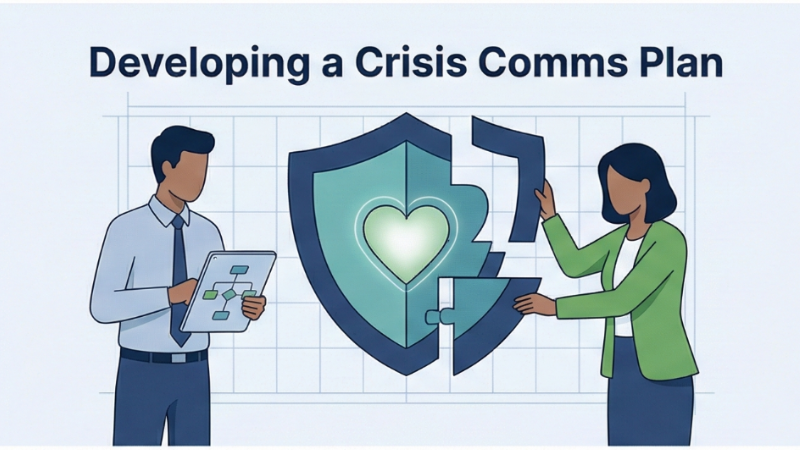
Developing a crisis comms plan is a pre-written, practical guide for what to say, who delivers the message, and which channels to use when something goes wrong.
It is not about predicting every scenario. It is about keeping a clear head when pressure spikes and emotions run high.
The goal is simple: protect reputation and maintain stakeholder trust through fast, accurate, and empathetic communication.
With roles defined and messages prepared, teams respond confidently instead of reacting blindly. Keep reading to learn how to build a plan that works when it matters most before headlines form and rumors spread uncontrollably online quickly.
Key Takeaways
- Define clear activation triggers and roles so everyone knows exactly when to act and what their job is, eliminating costly delays.
- Develop pre-approved message templates for likely scenarios, allowing you to communicate with empathy and facts within the critical first hour.
- Treat your plan as a living document by regularly testing it with drills and updating it based on new risks and lessons learned.
Defining & Creating Your Crisis Communication Plan
We often think of a crisis as a dramatic, headline-grabbing event. A data breach. A product recall. But it can be quieter, too.
A key executive departure handled poorly, a viral social media complaint, a local outage that impacts hundreds of customers.
A crisis communication plan is the structured process we use to talk about any event that threatens our operations, reputation, or stakeholder trust.
It’s different from a general crisis management plan. That plan focuses on fixing the operational problem, stopping the breach, recalling the product.
The communications plan focuses on explaining the situation. It answers the questions everyone is asking:
What happened? What are you doing about it? How does this affect me? Without clear answers, silence or confusion fills the void, and that’s where reputations are damaged.
So, where do we start? We start by looking inward. A useful first step is a simple risk assessment. We ask ourselves, what could realistically go wrong in our specific business? A tech startup’s risks look different from a farm’s.
Consider these categories:
- Operational: Supply chain breakdown, IT system failure, workplace safety incident.
- Financial: Sudden market loss, fraud, liquidity issues.
- Reputational: Negative viral news, executive misconduct, social media backlash.
- External: Natural disasters, new regulations, geopolitical events.
We don’t need to plan for asteroid strikes. We prioritize the scenarios that are both likely and would have a high impact. For each priority scenario, we begin drafting the core of the plan: the messages.
Crisis Roles & Responsibilities
A plan on paper is useless if no one knows who’s in charge when the alarm sounds. Confusion over roles wastes precious minutes, and in a crisis, minutes feel like hours.
We need a designated team, with backups for every role. This isn’t about titles, it’s about function. The core team usually includes these key players. Think of it as a small, agile unit.
| Role | Primary Duty | Why It Matters |
| Crisis Lead | Ultimate decision-maker. Activates the plan and has final say on messaging. | Provides clear authority. Often the CEO or a senior exec, their involvement signals the issue’s seriousness. |
| Lead Spokesperson | The public face. Delivers all official statements to media and public. | Ensures a single, consistent voice. This person must be media-trained and able to project calm empathy. |
| Legal Advisor | Reviews every word for liability and compliance. Advises on regulatory messaging. | Protects the organization from legal missteps that could compound the crisis. |
| Operations Lead | Provides the factual timeline: what happened, what’s being fixed, the ETA. | Keeps messaging grounded in operational reality, not speculation. |
| Communications Lead | Coordinates all messaging channels, drafts statements, manages internal comms. | The operational engine of the plan, making sure the right message reaches the right audience at the right time. |
We also need to define an activation protocol. What specific event triggers the plan? Is it a top-tier news inquiry? A certain duration of service outage?
A formal regulatory notice? Having a clear, objective trigger prevents debate and delay. When “X” happens, the team is alerted automatically. This structure turns panic into procedure.
The Messaging Backbone: Templates & Channels

When a crisis hits, our brains don’t work at their best because we have to identify and prepare for it. Writing from scratch is slow and risky.
This is where pre-approved templates become our most valuable asset. They’re not scripts to read robotically, but frameworks that ensure we hit the right notes immediately.
A basic holding statement template, for instance, might follow this structure:
- Empathy/Acknowledgment: “We are aware of the reported issue and are deeply concerned for those affected.” Research demonstrates that expressing empathy during crises significantly reduces reputational damage and increases stakeholder forgiveness by fostering emotional connection between organizations and their audiences. [1]
- Fact (Brief): “We are currently investigating a system outage impacting our mobile application.”
- Action: “Our technical team is actively working to resolve this. We have activated our crisis protocol.”
- Next Steps: “We will provide another update within 30 minutes via our website and Twitter account.”
This can be adapted and fleshed out in minutes, not hours. We should have templates for internal staff emails, customer service scripts, and draft press releases for our most likely scenarios. Legal should review these in advance, during a calm period.
This approach aligns closely with best practices in PR crisis and reputation management, where speed, clarity, and consistency protect public trust when it matters most.
Equally important is our channel strategy. Where will we push these messages? A multi-channel approach is non-negotiable.
- Internal: Email, SMS alert system, intranet. Employees must hear news from us first.
- External Public: A dedicated crisis page on our website (the single source of truth), our primary social media channels.
- Media: Direct outreach to key reporters on our roster, coupled with a broad distribution via a trusted press release service to ensure our official version of events is accessible and picked up by major outlets.
- Stakeholders: Direct calls or emails to investors, key partners, and regulators.
The goal is to flood the zone with accurate, consistent information, making it harder for speculation and misinformation to take root.
Testing, Storing, & Updating Your Crisis Plan
Credits: AlertMedia
A plan that sits in a binder on a shelf is a fiction. It gives a false sense of security. We only know if it works if we pressure-test it.
This means running exercises, what many call tabletop drills. Every six months or so, the crisis team should gather for a 90-minute session.
We present a scenario. “A video has gone viral showing a maintenance technician from our company acting unsafely at a client’s home.
It has 500,000 views in two hours and local news is calling.” Then we walk through the plan. Who activates it? What’s our first internal message? What does the holding statement look like? Where do we post it?
These drills reveal gaps. Maybe the legal counsel’s contact info is outdated. Perhaps the drafted template is too technical for the public.
We find the flaws in a room where the stakes are zero, so we can fix them before a real event. It’s also training. It builds muscle memory so the process starts to feel familiar, not frightening.
Access is critical. The plan must be stored somewhere every team member can access immediately, day or night, from anywhere.
A secure cloud drive is ideal. A printed copy in the office is useless if the crisis happens at 2 AM or if the office is unreachable. We should maintain a digital “crisis kit” with the plan, templates, updated contact lists, and social media login credentials.
Finally, this is a living document. After every drill, we update it. After any real-world minor incident (a small social media flare-up, a brief service interruption), we debrief.
What did we learn? If we launch a new product or enter a new market, we reassess our risks. The plan should be reviewed formally at least quarterly. It evolves as our business evolves.
From Theory to Practice: A Hydroponics Example

Let’s make this concrete. Imagine we run “Urban Greens,” a company selling home hydroponics kits. Our risk assessment flagged a potential issue: if a faulty water pump overheats, it could, in a worst-case scenario, cause a small electrical fire.
Our plan for this “product safety incident” would be activated by the first confirmed report from a customer. The team is alerted via a dedicated SMS group.
Our pre-written template is adapted. The spokesperson posts on our channels: “We are investigating a reported safety incident involving the Model X water pump.
Customer safety is our absolute priority. Please unplug your Model X pump immediately and visit our safety page for instructions.” This goes out within 20 minutes.
Internally, the ops lead works with the supplier to identify the batch. The comms lead prepares a detailed press release with the findings and remedy (free replacement, extended warranty).
To ensure this critical corrective message reaches beyond our existing customers and gets in front of journalists and the broader public searching for information, we’d use a professional distribution service to place the release on major news feeds.
This action demonstrates transparency and control. Meanwhile, customer service uses pre-approved scripts to handle inquiries. The entire response is coordinated, factual, and centered on customer safety.
Your Plan in Action: The First Critical Hours

The initial phase of a crisis sets the narrative. Research, and hard experience, shows that organizations have about an hour to acknowledge a brewing crisis before they lose control of the story.
This doesn't mean we have all the answers. It means we must communicate that we are aware and we are on it. [2]
A simple "We are aware and concerned" does more for public perception than a cold, factual statement. It's human.
After empathy, we state the facts we can confirm, however limited. Then we state what we’re doing. “We have activated our crisis team and are investigating.” Finally, we tell people when they’ll hear from us next. “We will provide another update by 4 PM ET.”
This cadence of updates is vital. Even if the update is “We are still investigating and will have more information by 8 AM tomorrow,” it stops the vacuum of silence.
It shows we haven’t gone to ground. We must monitor social sentiment and news mentions closely during this time, using simple tools to track the conversation. This allows us to correct misinformation quickly and understand public concerns.
The Path Forward After the Storm

When the immediate fire is out, our work isn’t done. We must conduct a formal post-crisis review. This isn’t a blame session. It’s a learning session.
We gather the team and ask: What went well? Where did we stumble? Was our contact list current? Did our templates work? Were our channels effective?
We document these lessons and update the plan accordingly. Maybe we need a new template for a scenario we hadn’t considered.
Perhaps we need to add a new communication channel. This review closes the loop and makes our plan stronger for the next time.
Because in business, it’s not about if something will happen, but when. Our preparation defines the outcome.
FAQ
What are the essential components of a crisis comms plan development process?
A solid crisis communication strategy framework starts with understanding your risks and assembling the right team. You'll need an incident response team assembly that includes PR, legal, HR, and operations folks.
Build your reputation management crisis playbook with holding statement templates, key message development process guidelines, and spokesperson training protocol.
Don't forget practical tools like contact directory maintenance, escalation decision tree charts, and a risk assessment matrix crisis teams can reference quickly.
Include scenario planning templates comms staff can adapt, plus emergency response messaging protocol that covers different situations.
Finally, set up your communication channel prioritization so everyone knows which platforms to use first during an actual emergency.
How should organizations structure their stakeholder engagement crisis guidelines?
Your stakeholder engagement crisis guidelines need clear audience prioritization matrix tools and message consistency rules everyone follows.
Start with employee notification cascade procedures so your team hears news internally first, then map customer update timelines and regulatory reporting workflow requirements.
Set up an approval hierarchy chart that shows who reviews what, including the legal review approval chain for sensitive statements.
Build in investor relations briefings, board reporting templates, and vendor liaison plan procedures. For external groups, establish media relations crisis procedures, community outreach response protocols, and transparency principles crisis teams must follow.
The goal is reaching the right people at the right time with unified voice guidelines that maintain trust.
What tools and templates make crisis response more efficient?
Practical templates save precious time when pressure hits. Create holding statement templates, FAQ scripting process guides, and press release drafting checklist documents your team can grab immediately.
Develop email blast templates crisis teams can customize, call center response scripts, and website crisis banner guidelines. Set up a social media monitoring dashboard and status page deployment system for real-time updates.
Include apology statement guidelines following the empathy facts action model, plus executive briefing notes template formats.
Don't overlook SMS alert system setup, intranet announcement procedures, and news conference protocols.
Stock your digital crisis toolkit with message templates that match your communication channel prioritization strategy and response speed benchmarks.
How do you prepare spokespeople and establish PR crisis activation triggers?
Spokesperson training protocol should cover the key message development process, teaching designated speakers how to stay on message under pressure.
Establish backup spokesperson designation so you're never caught without someone ready. Your PR crisis activation triggers need clear definitions, create an escalation decision tree showing exactly when to activate your plan based on severity and impact.
Include credential access protocols so spokespeople can quickly reach necessary systems. Set response speed benchmarks and practice through tabletop exercise drills at least twice yearly.
Train on crisis leadership principles emphasizing safety first messaging and accountability statement framework.
Schedule media roster updates quarterly and conduct annual plan audit schedule reviews to keep everything current.
Your Next Step for Controlled Communication
A robust crisis communication plan transforms panic into procedure. It ensures your side of the story is heard clearly and widely when it matters most. For distributing those critical official statements with speed and reach, consider using a dedicated service like NewswireJet to amplify your message to major media outlets. Start building your shield of trust today.
References
- https://www.sciencedirect.com/science/article/abs/pii/S0363811119301833
- https://instituteforpr.org/crisis-management-and-communications/
Related Articles