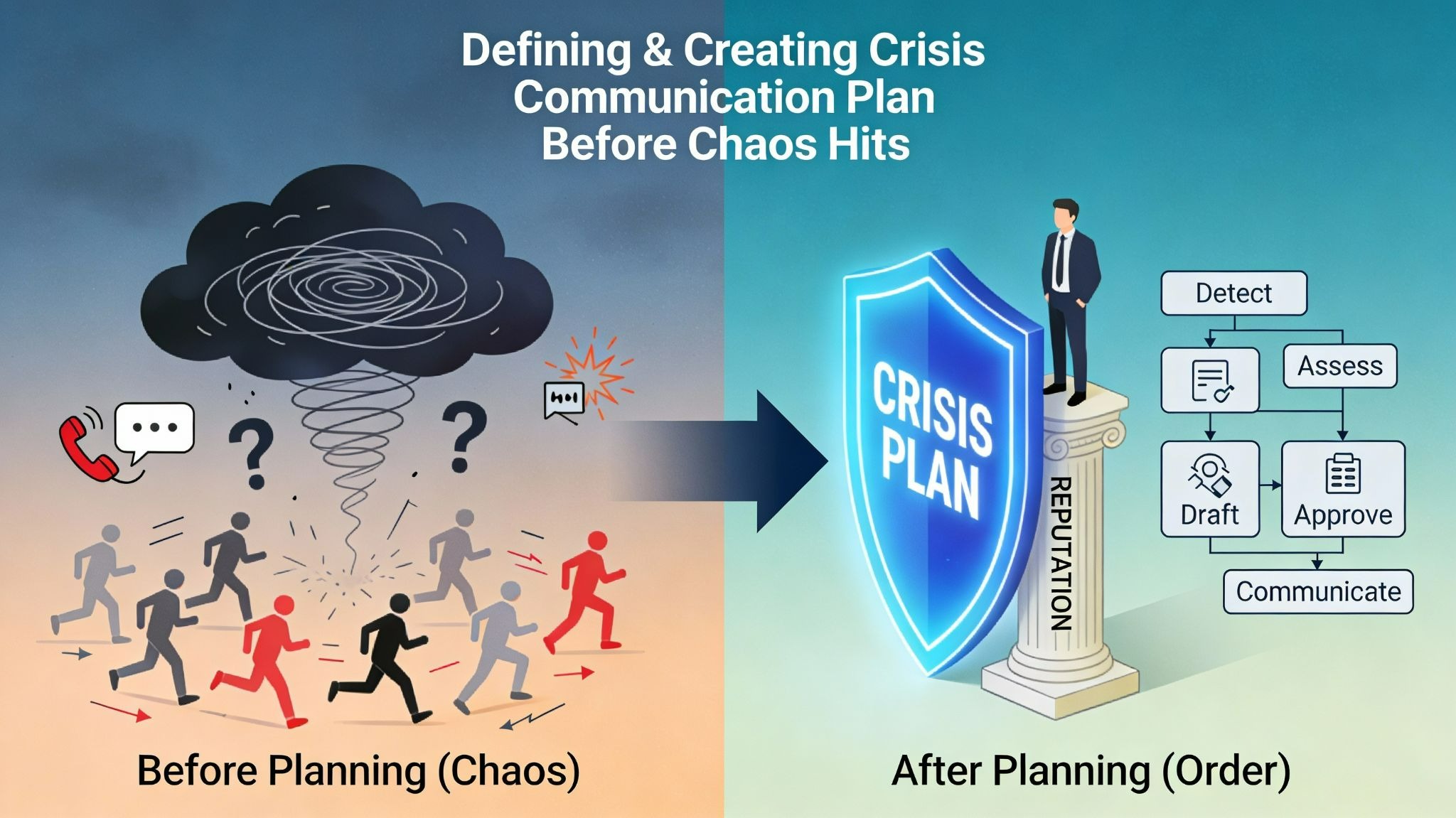
When the call comes in about a data breach, a failed product, or a viral social media storm, your response defines you.
A crisis communication plan is the single document that moves your team from panic to procedure. It’s your pre-built framework for speaking with one clear, empathetic voice when everything is on the line.
Without defining & creating crisis communication plan, you’re just hoping for the best. Let’s walk through how to build one, using a model that makes it a living, breathing part of your operations, not a forgotten file. What you do in the first hour sets the tone for recovery, so keep reading to build your blueprint.
Key Takeaways
- A crisis plan prioritizes rapid, empathetic, and transparent messaging to control the narrative and protect stakeholder trust.
- Building your plan requires identifying specific risks, designating a clear team with backups, and creating pre-approved message templates.
- The plan must be a living document, regularly tested through drills and updated based on real events and debriefs.
Defining What This Plan Actually Is
Let's strip away the jargon. For us, a crisis communication plan is a strategic playbook for information. It's a subset of your broader reputation management effort.
While other teams fix the servers or manage the recall, this plan governs all communication, internal and external.
Its primary goal is to protect trust. It does this by ensuring timely, accurate, and consistent messaging across all channels to minimize confusion and demonstrate control.
We think of it as the central nervous system for your response, carrying signals of clarity to every stakeholder.
The core principles are simple but non-negotiable. Transparency isn't just a buzzword, it's the only currency that buys back trust in a crisis.
You have to be proactive, anticipating questions before they're screamed online. And you must deliver your messages multi-channel, because your employees check email, your customers live on social media, and the press monitors your newsroom. A single channel always fails.
- Transparency: Builds trust by filling the information vacuum with facts.
- Proactivity: Anticipates stakeholder questions and addresses them head-on.
- Multi-Channel Delivery: Ensures the message reaches every audience where they are.
Why Every Organization Needs a Crisis Communication Plan

Crises don’t wait for approval cycles. They happen fast, publicly, and often without warning. Organizations without a defined communication plan tend to react emotionally, contradict themselves across channels, or go silent, each option erodes trust.
A crisis communication plan exists to eliminate hesitation. It gives teams confidence to act, not debate.
It also protects leadership from becoming the bottleneck when decisions need to move at real-time speed.
Most importantly, it ensures stakeholders hear from you first, not from speculation, screenshots, or comment sections doing investigative journalism at warp speed.
A Real-World Lesson: When Silence Becomes the Crisis

We remember working with a small agrotech startup when a key hydroponics sensor failed across several major farms.
The operational problem was bad enough. The communication vacuum that followed was worse. Panicked customers flooded social media, speculation ran wild about crop losses, and the local news picked up the story.
The founders were brilliant engineers, but they were stuck debating the perfect technical explanation while their reputation quietly combusted.
That experience, and dozens like it, cemented our view: a crisis communication plan isn’t public relations fluff.
It’s operational continuity for your reputation. It answers the “what do we say?” question with a calm, pre-defined voice, so you can focus on solving the actual problem.
The Core Principles That Guide Every Crisis Response
Credits: C3 - NCIER
Strong crisis plans don’t rely on improvisation. They rely on principles that hold under pressure.
- Transparency: Filling the information vacuum with facts builds credibility, even when the news isn’t good.
- Proactivity: Anticipating stakeholder questions prevents speculation from filling the gaps.
- Multi-Channel Delivery: One channel is never enough. Stakeholders live in different places, and your message must meet them there.
When these principles guide decision-making, consistency follows naturally.
The EAV Model: A Blueprint for Your Plan
Faced with a complex problem, we often break it into smaller, manageable parts. We apply this same logic to building a crisis plan using an Entity-Attribute-Value (EAV) model. It turns a daunting document into a dynamic, searchable system. [1]
Each component is a building block. You can update a contact list without rewriting the entire plan. You can pull the specific protocol for a data breach instantly.
This modular approach makes the plan a living document, easy to maintain and actually use under pressure. The table below outlines the core framework.
| Entity | Attribute | Value (The Actionable Detail) |
| Crisis_Plan | Core_Principle | Empathy and facts first. Public acknowledgment must occur within 15-30 minutes of a confirmed incident. |
| Team_Roles | Crisis_Manager | The strategic lead with ultimate authority to activate the plan. They ensure full team mobilization in under 30 minutes. |
| Team_Roles | Primary_Spokesperson | The calm, media-trained public face. For global teams, we also designate bilingual leads for specific regions. |
| Scenarios | Activation_Trigger | Defined thresholds that kick the plan into gear. Examples: confirmation of a safety issue, or 1,000+ negative social mentions in an hour. |
| Messaging | Holding_Statement_Template | A pre-written, legally-reviewed statement: "We are aware of [issue]. Our team is investigating and we will provide an update by [specific time]." |
| Channels | Internal_Alert_Protocol | Step 1: SMS alert to the crisis team. Step 2: All-hands email with initial facts and a link to the internal briefing page. |
| Testing | Drill_Schedule | Quarterly tabletop exercises for specific scenarios. One annual full simulation with mock media inquiries. |
| Maintenance | Review_Cycle | A mandatory post-crisis debrief within 72 hours. A formal bi-annual review of the entire plan, from contacts to scenarios. |
This model is your digital crisis toolkit. It moves you from a static PDF to a functional system. When news breaks, your team isn't searching a 40-page document.
They're checking the "Spokesperson" protocol and the "Holding Statement" for the relevant scenario. It brings order to chaos.
Why Modular Crisis Plans Work Better Under Pressure
Traditional crisis plans fail because they assume calm reading environments. Reality looks more like Slack pings, breaking news alerts, and leadership asking for updates every three minutes.
The EAV model works because it mirrors how teams behave in real crises: they search, scan, and act. By designing the plan around access speed, not theoretical completeness, you dramatically improve execution quality when it matters most.
Building Your Plan: A Phased Approach
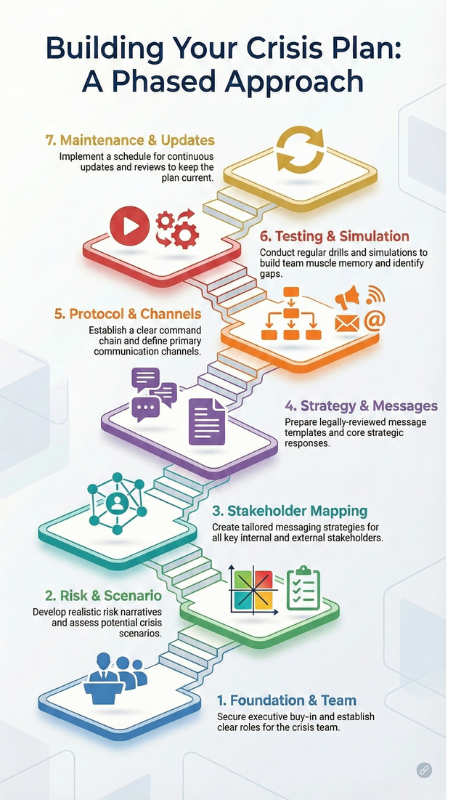
You can’t build a reliable crisis plan in one brainstorming session. It requires a phased, intentional process. We use a seven-phase approach that moves logically from preparation to execution.
Phase 1: Foundation and Team Mobilization
Executive buy-in comes first. Without leadership support, the plan has no authority. From there, assemble a cross-functional crisis team, Communications, Legal, Operations, HR, and IT, with clear backups for every role. Each member receives a one-page activation summary outlining their first three actions.
Phase 2: Risk and Scenario Assessment
Generic plans fail. Specific ones survive. Identify realistic risks using a likelihood-versus-impact matrix. For each high-risk scenario, outline a brief narrative so teams aren’t imagining the crisis for the first time during the crisis.
Phase 3: Stakeholder Mapping and Impact Analysis
Different stakeholders care about different things. Employees worry about safety and job security. Customers want clarity.
Regulators want compliance. Mapping these concerns ensures messaging addresses real needs, not corporate assumptions.
Phase 4: Strategy and Message Development
This is where empathy meets structure. Develop messages for each crisis stage: acknowledgment, investigation, and resolution.
Draft legally reviewed crisis comms templates for press and social media so speed never compromises accuracy.
Phase 5: Protocol and Channel Build-Out
Define the chain of command, war room logistics, channel ownership, and access credentials. Internal alignment is critical here, effective pre-crisis internal communication ensures employees are informed before external narratives form.
Phase 6: Testing Through Realistic Simulation
A plan untested is a plan untrusted. Regular tabletop exercises build muscle memory and preparedness, transforming crisis procedures from abstract concepts into practiced skills teams can execute under pressure. [2]
Quarterly tabletop drills and annual full simulations reveal gaps safely, before real reputations are on the line.
Phase 7: Maintenance as a Living Document
Every incident and drill ends with a debrief. Updates happen immediately. Bi-annual reviews ensure contact lists, risks, and tools evolve alongside your business and emerging threats like AI-generated misinformation.
The Unbreakable Rules of Crisis Response

Some truths are learned the hard way:
- Speed beats perfection, acknowledge within minutes, not hours
- Internal communication always comes first
- Continuous monitoring prevents misinformation from spreading
- Empathy isn’t optional, it’s foundational
These rules anchor teams when pressure blurs judgment. It is not an admission of legal fault, it's an acknowledgment of human consequence.
FAQ
What is the crisis communication plan definition and why do organizations need one?
A crisis communication plan definition describes a documented strategy for responding to emergencies that threaten your organization's reputation or operations.
Think of it as your emergency messaging framework, a roadmap showing exactly who says what, when, and through which channels during tough situations.
The crisis comms plan creation process helps you prepare for scenarios like data breaches, product recalls, or natural disaster comms situations before they happen.
Without one, teams scramble and make mistakes under pressure. A solid reputation protection strategy includes your crisis team structure, escalation procedures plan, and activation triggers crisis leaders use to launch response efforts.
It's essentially your incident response playbook that turns chaos into coordinated action when things go wrong.
How do you structure an effective crisis team and define roles?
Your crisis team structure needs clear roles with backup spokesperson roles for continuity. Start with a chain of command crisis that shows who's in charge and establishes credential access protocols so the right people can act quickly.
Include PR crisis guidelines for communications staff, legal review process requirements, and regulatory compliance comms responsibilities.
Set up a war room setup plan and command center logistics for your physical response space. Define spokesperson training protocol so designated speakers understand key message development techniques.
Establish a unified voice protocol ensuring message consistency across all channels. Don't forget vendor communication plan procedures and volunteer coordination comms if you work with external partners.
Getting executive buy-in crisis early ensures leaders commit resources and participate when needed.
What templates and tools should be included in a digital crisis toolkit?
Your digital crisis toolkit needs practical resources teams can grab immediately. Start with a holding statement template, pre-approved press releases, and bilingual messaging templates if you serve diverse audiences.
Include an outage response template, data breach protocol guidelines, and product recall messaging frameworks for common scenarios.
Add scenario planning templates covering situations from viral misinformation response to natural disaster comms.
Build in social media response plan procedures with social listening tools and sentiment analysis tools for monitoring.
Create a one-page activation summary showing activation triggers crisis and your decision tree crisis for quick reference.
Including communication channels, crisis teams should prioritize and monitor tools crisis managers need. Stock employee guidelines, crisis documents, customer trust recovery messaging, and investor relations updates templates for different audiences.
How do you develop key messages and establish communication protocols?
Key message development starts with empathy first messaging, then layers in facts-first updates and action-oriented language that tells people what to do next.
Follow the EFA messaging structure (empathy, facts, action) as your foundation. Your stakeholder communication protocol should define multi-channel delivery methods reaching internal alerts crisis audiences before external notifications crisis go out.
Establish a 15-minute acknowledgment standard so people know you're aware and working on issues. Set progress update cadence expectations, how often will you communicate as situations evolve?
Include cultural sensitivity comms guidelines and bilingual messaging templates like Indonesian bilingual comms if you operate in specific regions.
Build media relations crisis procedures and influencer engagement crisis protocols. The legal review process must balance transparency with protecting your organization while maintaining accountability statements throughout.
From Blueprint to Bulwark
Your crisis communication plan is the quiet work you do today so you can lead with confidence tomorrow. It transforms potential reputation disaster into a managed incident. It is, fundamentally, a plan for protecting the trust you’ve worked so hard to build. For amplifying your positive news with strategic reach, consider a partner like NewswireJet. Start building your bulwark today.
References
- https://pmc.ncbi.nlm.nih.gov/articles/PMC2110957/
- https://www.tandfonline.com/doi/full/10.1080/1553118X.2018.1510405
Related Articles