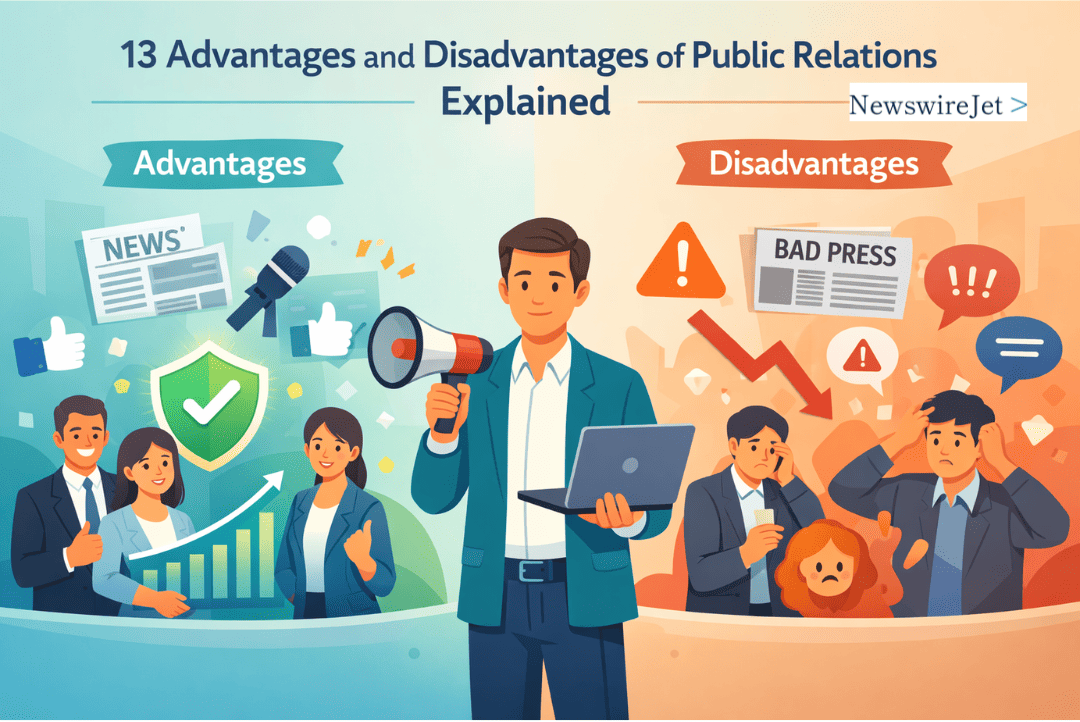
Forget the textbook definition. Public relations is the work of getting people to believe in your company without paying for the privilege.
It's the positive news article, the respected industry award, the community project that makes locals think well of you.
This earned credibility is powerful, but it comes with strings attached.
You can't dictate the final message, and connecting a press clip directly to a sale is notoriously difficult.
Below, we'll walk through the concrete advantages and the unavoidable headaches of PR, so you can decide if it's a fit.
PR at a Glance, What Matters Most
Public relations can elevate a brand’s reputation over time, but it also carries risks that require patience and careful management.
- PR builds trust and credibility through third-party media coverage
- Results take time and are hard to measure or control
- Negative publicity can spread quickly and damage reputation
Advantages of Public Relations
1. Credibility and Trust
Ads are obvious. You see them, you know someone paid for them. News is different. When a company shows up in a real article, people believe it.
That’s the core advantage of PR. It borrows the credibility of the media outlet itself. A mention in a reputable publication makes a business seem established, like an authority in its space.
Think about it. If you read about a company in The Wall Street Journal, your impression changes. You start to trust them.
PR teams spend their days trying to earn that spot. They pitch stories to journalists, arrange for experts to speak on behalf of the brand, and build narratives that are interesting enough to get printed.
This shapes public perception more deeply than any advertisement could. Ads face instant skepticism. Earned media feels like independent validation.
Key Points:
- PR gains trust by leveraging media credibility
- News coverage feels more authentic than paid ads
- Mentions in reputable outlets boost authority
- PR teams craft stories to attract journalist interest
- Earned media acts as independent validation
- Ads are often viewed with immediate skepticism
2. Cost-Effective Marketing Strategy

Advertising budgets can be huge. PR is often about working smarter, not spending more. You’re not buying a billboard or a TV slot. You’re investing in relationships and storytelling.
A press release costs $500-2K to produce professionally but can yield $10K+ in equivalent ad value via reprints.
Collaborating with an influencer or a respected figure in your industry can yield a powerful recommendation. Sometimes it’s free, sometimes it’s a fraction of an ad buy. That recommendation has more sway with audiences.
For many businesses, the payoff from PR is longer-lasting. An ad campaign runs for a month and then it’s over.
The coverage from a PR win continues to work. It sits online, gets referenced, and keeps the brand’s name alive in conversations long after the initial effort.
Key Points:
- PR focuses on strategy and relationships rather than large ad spending
- Press releases can generate wide exposure at minimal cost
- Influencer or expert endorsements carry strong persuasive power
- Recommendations often outperform traditional advertising in trust
- PR results can deliver long-term visibility beyond campaign periods
- Earned coverage continues to promote the brand over time
3. Improved Brand Awareness and Visibility
A well-run PR campaign gets a company noticed. It works by getting stories into the news, running events, and forming partnerships.
When a business launches a product, wins an award, or has an executive publish an article, PR makes sure that story gets out.
Take a startup that gets a write-up in a respected trade magazine. Suddenly, it's on the radar for investors and potential clients.
A company that sponsors a local charity event or joins a town clean-up project also builds its profile. People start to remember the name and feel more connected to it.
PR staff make this happen. They send story ideas to reporters, use social media to spread news, and set up events that journalists will want to cover.
They don't sit back and hope for attention; they actively work to get it. This keeps a brand from being overlooked in a competitive field.
4. Stronger Media Relationships
At its heart, PR is about building real, working relationships with reporters, bloggers, and news editors. These connections mean a business can expect more regular, and more positive, coverage.
It becomes a place the media goes to for quotes or background on its sector.
PR people focus on this. They give journalists useful data, issue press releases when they are actually relevant, and offer access for interviews.
When you're seen as a credible and helpful source, you get called more often. That steady stream of mentions builds up how the public views your firm.
Having these ties also means a single press release is more likely to appear in several different outlets, widening its impact.
This becomes absolutely vital if a crisis hits. Good relationships with the media allow you to get your version of events out quickly, before rumors and speculation take over.
Key Points:
- PR builds long-term relationships with media professionals
- Strong connections lead to more frequent and favorable coverage
- Credible sources are repeatedly contacted for expert commentary
- Relevant press materials increase chances of publication
- One release can spread across multiple outlets through established ties
- Media relationships are crucial for rapid response during crises
5. Crisis Management and Reputation Protection
Your brand’s reputation is a glass house. It looks solid until something hits it. Today, that “something” is usually online, a viral complaint, a leaked email, a product failure caught on video.
The damage spreads in minutes, not days. This is the moment a PR team proves its value. They aren’t magicians, but they are trained to step into the storm.
Their job is to manage the uncontrollable: public anger, media scrutiny, the frantic internal panic. They work to contain the story, protect what trust remains, and plot a course toward recovery.
According to Public Relations Review,
"The findings illustrate that public relations is seen not only as a mediator of social meaning but also as a producer of social outcomes, both positive and potentially harmful." - ScienceDirect
A real crisis plan isn’t a binder on a shelf. It’s a live nerve. It means someone is always watching,scrolling feeds, monitoring news alerts.
It means the first response is drafted under pressure and reviewed in minutes, not by committee over a week. And the core of it is a brutal, non-negotiable honesty.
Companies that fumble their crisis response often do so by trying to minimize or deflect. The public can smell that. People will tolerate a mistake; they won’t tolerate being patronized or misled.
Take a restaurant chain facing a food safety allegation. The legal team might advise saying nothing. The PR team knows that silence is guilt in the public’s eye.
Their work is to craft a holding statement that acknowledges concern, to get a credible spokesperson in front of cameras to explain the investigation process, and to push operations to demonstrate tangible changes,deep cleaning, retraining staff, whatever it takes.
The messaging has to match real action. It’s a tightrope walk between legal caution and public expectation, all while the news cycle churns.
Key Points:
- Crises spread fast online
- PR responds quickly
- Honesty builds trust
- Silence increases damage
- Actions must match words
6. Enhancing Customer Engagement and Loyalty
The old PR model was broadcast: send out the news and hope it sticks. The new model is magnetic: create something people want to be near. The difference is between making customers and creating advocates. It’s the gap between someone who buys your product once and someone who defends your brand online.
This isn’t about fluffy “engagement.” It’s a strategic shift in communication. It means a software company writing a detailed post about a difficult bug fix, treating users like peers.
It means a small brewery telling the story behind its ingredients, turning products into narratives. The focus moves from features to identity,what you stand for, not just what you sell.
That shared identity builds loyalty. People will pay more, wait longer, and stay committed because they feel connected. Businesses become part of a community or lifestyle, not just a transaction.
Key Points:
- Modern PR focuses on attraction, not broadcast
- Goal shifts from customers to brand advocates
- Storytelling builds identity and connection
- Transparency strengthens trust
- Shared values drive long-term loyalty
- Community ties make brands harder to replace
7. Competitive Advantage
Everyone's shouting for attention online. How do you get noticed without just shouting louder?
Good PR isn't about blasting your message. It's the opposite. It's getting someone else to tell your story for you.
Imagine a reporter writing about a problem your product solves, and mentioning your company as an example.
Or a well-known blog asking your engineer for advice. That carries way more weight than any ad you could run yourself.
When people see your name in a place they already trust, they start to trust you, too. They think, "If this publication is talking about them, they must know what they're doing."
Your competitors might have flashier ads, but you've got third-party credibility. That's what makes customers choose you and stick with you.
It's less about selling and more about building a reputation that does the work for you.
Disadvantages of Public Relations
It's not all press releases and good headlines. Public relations has real pitfalls that can frustrate any business, and understanding the disadvantages of public relations early helps organizations prepare for what they may encounter.
| Disadvantage | What It Means | Potential Risk |
| Lack of Control | Media decides how the story is presented | Message distortion |
| Hard to Measure ROI | Direct sales impact is unclear | Budget justification challenges |
| Slow Results | Requires long-term effort | Not ideal for urgent goals |
| Negative Publicity | Bad news spreads quickly | Reputation damage |
| Media Dependency | Success relies on relationships | Coverage uncertainty |
| Need for Experts | Skilled professionals required | High costs for small businesses |
1. Lack of Direct Control
You send out information hoping for a good story. What you get back is someone else's interpretation.
A journalist might ignore your main point to focus on a minor detail, or they could frame a neutral update as a sign of trouble.
Once that story is published, it's the truth for most readers. Fixing it means scrambling, correcting the record, managing internal panic, and hoping the outlet will even run a follow-up. You're always one bad quote away from a crisis.
According to European Journal of Marketing,
"Though it has its undeniable benefits (it grabs attention and helps circulate more information), it also has costs (such as selective messaging)." - Emerald Insight
Key Points:
- Media controls the final narrative
- Key messages can be overlooked
- Neutral news may be framed negatively
- Corrections are difficult and slow
- One misquote can trigger a crisis
2. Difficult to Measure ROI
Ask a marketer about an ad campaign, and they'll show you click-through rates and sales data. Ask a PR person about their latest campaign, and the answer is less concrete.
They'll talk about "earned media" and "share of voice."
They can show you a pile of clippings.
But direct sales links remain challenging, as much of the impact relies on qualitative PR data rather than clear quantitative sales figures, even though tools now track sentiment/share of voice with 80% accuracy.
The value is in the background noise of public opinion, which is infuriatingly hard to measure on a spreadsheet. This makes PR an easy target when budgets get tight.
3. Time-Consuming Process
PR isn't a quick fix. It's more like tending a garden than flipping a switch, especially when teams face ongoing PR and marketing alignment challenges while coordinating messaging across channels.
You have to put in the work consistently, build real connections, and plan for the long haul. With paid ads, you get traffic immediately. PR campaigns take longer to gain any real traction.
Consider trying to get a story in a notable outlet, or building a network of reporters who will actually answer your emails. That takes months. It involves outreach, follow-ups, and adapting your message to the news cycle.
For a company wanting results tomorrow, PR feels slow. Compared to most other marketing tactics, it absolutely is.
Key Points:
- PR delivers results slowly
- Requires consistent long-term effort
- Building media relationships takes months
- Depends on timing and news relevance
- Slower than paid advertising for immediate impact
4. Potential for Negative Publicity
Good PR builds trust. Bad PR destroys it. A single misstep, a poorly judged campaign, or a string of negative articles can flip the script entirely.
Once a damaging story gets online, it's everywhere in minutes, and controlling it becomes a huge fight.
Consider a company that has to recall a product. Suddenly, years of positive reputation work mean nothing.
The news is all about the failure. Or picture a CEO's controversial tweet going viral. The brand gets tied to that mistake, sometimes for years.
Without a plan for these moments, a company is just reacting, and usually too late. You need a crisis playbook ready to go,not to avoid all bad news, but to have a fighting chance of steering the conversation.
Key Points:
- Reputation can collapse quickly
- Negative news spreads fast online
- Past goodwill may not protect you
- Leadership missteps can damage the brand
- Crisis planning is essential for response
5. High Dependency on Media Relations
Getting a company's name in the news isn't just about having a good story. It's about who you know. If your PR team doesn't have solid relationships with reporters, bloggers, and key voices, your pitches will probably just get deleted.
The work is constant, you're always meeting people, selling ideas, and tracking what matters to them now.
And that last part is key. Media trends change. A PR strategy that worked perfectly a few years ago might fall flat today. You have to adapt, sometimes completely, or risk losing visibility to competitors who do.
Key Points:
- Media coverage depends heavily on relationships
- Weak networks lead to ignored pitches
- PR requires continuous outreach
- Journalist interests shift over time
- Strategies must evolve with media trends
- Competitors who adapt gain coverage advantage
6. Requires Skilled Professionals
Credits: TopLine Film
Getting your company's story into the world isn't easy. You need to know how to write a press release that an editor will actually open, how to reach reporters, and how to respond when issues go public.
Most business owners aren't experts at this.
The common solution is hiring a PR agency or consultant. They bring contacts, experience, and a higher chance of results.
But that expertise is expensive. For smaller businesses, the cost often outweighs the potential return.
Key Points:
- PR requires specialized skills
- Most owners lack media expertise
- Agencies provide contacts and experience
- Professional PR services are costly
- High fees can strain small-business budgets
- ROI may not justify the expense
FAQ
How does public relations improve brand awareness without paid advertising?
Public relations improves brand awareness by securing media mentions in trusted media outlets and news media. When journalists cover a story, it reaches audiences who often ignore advertisements.
Consistent media coverage across online publications, local television stations, and social media platforms increases brand recognition and shapes positive public perception, helping a business remain visible without paying for ads.
Can public relations shape public perception during a crisis?
Public relations can strongly shape public perception during a crisis. PR professionals coordinate crisis management efforts, communicate with media personnel, and provide accurate information to news outlets.
Timely updates across news media and social media reduce misinformation, demonstrate accountability, and protect the organization’s public image, which helps maintain media trust and support effective reputation management.
Why are journalist relationships important for long-term media coverage?
Journalist relationships are essential for long-term media coverage because they build trust between PR professionals and media personnel.
Reporters prefer reliable sources who provide accurate information and respond promptly.
Over time, strong media relations lead to more frequent media hits, expert commentary requests, and inclusion in ongoing media trends, which strengthens thought leadership and visibility.
How does public relations support social media engagement?
Public relations supports social media engagement by turning media coverage into shareable content that encourages discussion and interaction.
Stories published in news outlets often spread across social media platforms, increasing social engagement and reinforcing brand image.
Effective storytelling techniques make audiences more likely to comment, share, and discuss the content, which expands reach organically.
Is public relations a reliable long-term marketing strategy?
Public relations can be a reliable long-term marketing strategy, but it does not provide a guaranty of results.
Success depends on a well-planned media strategy, strong media relations, and consistent communication.
When executed effectively, public relations strengthens brand credibility, entity authority, and search engine ranking through repeated exposure in trusted news media.
Make PR Work When It Matters Most
You put in the effort, send the pitches, and still wonder if anyone is actually paying attention.
It’s frustrating to invest time and budget without clear feedback or control over the outcome. Results feel slow.
If you want traction without guessing, try NewswireJet as a simple next step. It helps you get your story in front of real outlets faster, so you’re not waiting around for momentum.
References
- https://www.sciencedirect.com/science/article/pii/S0363811125000992
- https://www.emerald.com/insight/content/doi/10.1108/03090560910923337/full/html
Related Articles