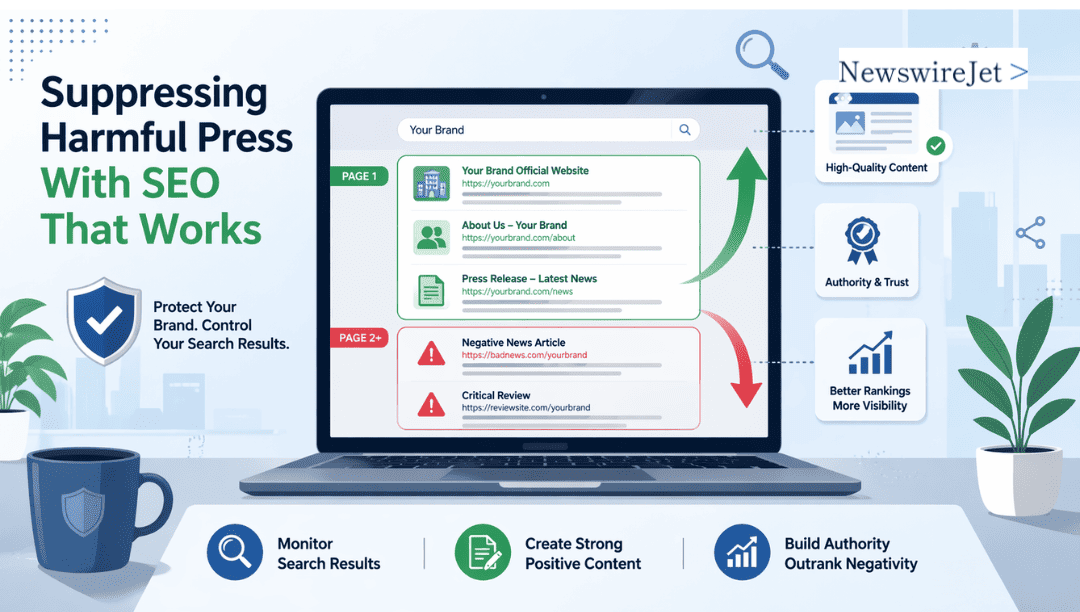
Bad press loses its power when your website outranks it. Think about it, 95% of clicks go to the first page of Google.
If a damaging story isn't there, most people won't see it. Google's algorithm looks for authority and relevance, not for perfect histories.
You can't usually delete a negative article. But you can build something better that pushes it down. This changes what people find, not what exists.
A disciplined SEO plan makes this shift possible. Keep reading to see how it's done.
SEO Reputation Quick Wins
Suppressing harmful press with SEO works by strengthening the positive signals that search engines trust most.
- Stronger branded assets can push negative search results below page one where visibility drops sharply.
- Consistent publishing and technical SEO improve Search Rankings for positive brand content.
- Authority signals and measurement determine whether a reputation management campaign is gaining traction.
Why SEO Matters for Suppressing Harmful Press
Think of search results as a front door. A negative article sitting there can turn visitors away before they step inside.
Google decides who gets to stand at that door. Its system grades every page on how useful, relevant, and credible it is. So the quality of your content isn't just a nice detail, it's the ticket to a better spot in line.
People hardly ever look past the first page of results. The number one link gets about 27% of all clicks. If you're not in that top group, you're missing most of the audience.
SEO suppression is one way to fix this. It's not about deleting things.
Removal tries to erase the harmful content, often through legal channels, such as approaches used when removing bad content with SEO. Suppression works differently.
You build new, stronger pages that search engines favor. These trusted pages climb above the bad ones, pushing them down the list. You don't delete the problem; you bury it underneath better stuff.
The aim is to own what people find when they search for you. Trying to get something permanently deleted is tough. Putting better content above it is usually the smarter, more achievable play.
How Search Result Suppression Actually Works
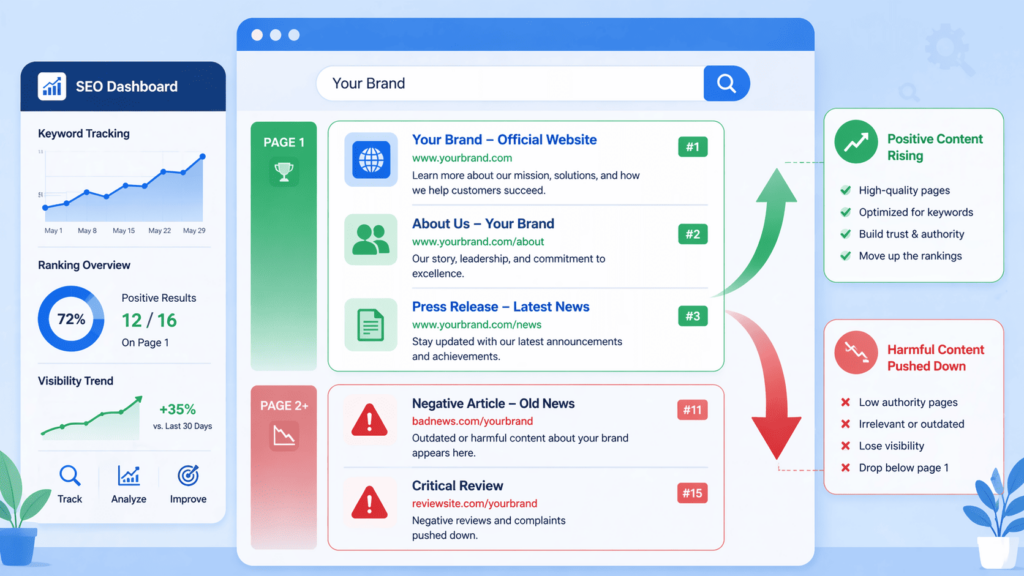
Search suppression isn't magic. It's a grind. Someone finds a damaging article or a bunch of bad reviews ranking for your brand name. The fix is to bury it, not delete it.
In many cases, companies focus on negative content suppression strategies that shift visibility away from damaging pages instead of trying to erase them completely.
You start by figuring out what people are typing to find that mess. It's usually "[Your Company] sucks" or "[Your Company] lawsuit" or "[Your Company] reviews."
According to University of Wollongong (UOW),
"Some methods [of suppression] include: ... submerging or diluting data in large quantities of contrary data; shifting attention away from particular data through diversionary data; misrepresenting data through the method of presentation, aggregation, or selection." - University of Wollongong
Then you build stuff, a lot of stuff, that answers those exact searches but tells a different story. You need volume. One or two pages won't cut it. You're competing with established news sites or angry forum threads.
What do you build? Anything Google will list.
- Deep-dive pages on your own site about company history or leadership.
- Executive profiles on professional networks.
- Byline articles on industry blogs or news sites.
- Fresh social media profiles filled with content.
- Press releases that get syndicated.
- Video interviews or explainers.
You might need 50 pieces. You might need 200. You watch the rankings in Search Console. Nothing happens for a while, then a few assets start to appear on page two. That's your signal.
The pieces have to work together. They use the same company name, the same executive names, and link to each other quietly. They all reinforce a single, clean narrative.
The last part is time. New content gets a small ranking boost. So you keep publishing. A new article here, an updated bio there. It's a slow push.
Over weeks and months, your stack of positive content gets heavier and starts to sink the old, negative result down the page. It doesn't disappear. It just gets pushed to page two, where almost no one will see it.
Which Keywords Should We Target to Outrank Negative Coverage
Bad search results start with specific phrases. You need to know which ones.
Check Ahrefs or Google Search Console. They show you the actual searches that lead people to the damaging pages. That's your starting list.
Some phrases are low-hanging fruit. They aren't fought over as much, so you can fix them quicker. Look for stuff like:
- Your brand name + "reviews"
- Your brand name + "customer service"
- Your brand name + "awards"
Going after these isn't just a quick fix. It's part of building a whole content ecosystem that makes your brand stronger in search.
Here's a straightforward guide on the types of phrases and the goal for each.
| Type | Example Search | Goal |
| Bad match | "[brand] scam" | Bury the negative result. |
| Good news | "[brand] awards" | Promote positive facts. |
| General info | "[brand] mission" | Fill the search page with your content. |
| People | "CEO of [brand]" | Add a human, trustworthy layer. |
A useful trick: longer, niche searches often rank faster. There's less competition for "how to reset [brand] password" than for just "[brand]".
You get quicker wins here, which helps while your main authority pages are still building up.
What Content Pushes Harmful Articles Down Fastest
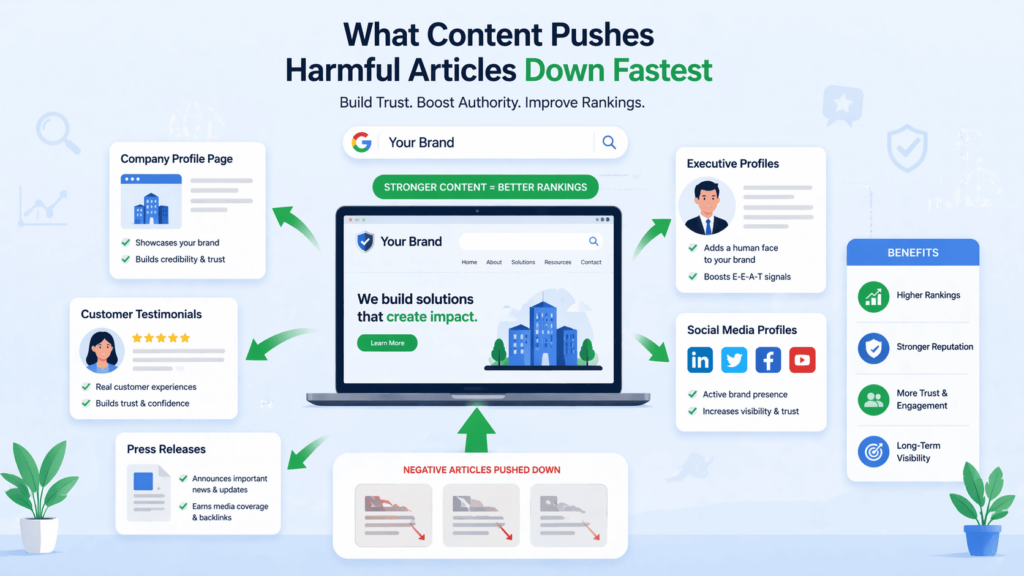
If you need to push harmful links off a search page, your best bet is your own high-authority content. It's the fastest method.
Putting that content on your own website is crucial. You own the structure, you handle the updates, you control the metadata. Search engines see that consistency and reward it.
Professional profiles count too. A LinkedIn page, for instance, often ranks high for searches about a person or their company. The platform itself has strong trust signals.
So, what should you publish? Focus on:
- Leadership profiles.
- Customer stories.
- FAQ pages.
- Press releases.
- Thought leadership articles.
- Official social profiles.
How often you publish is a big factor. To create the momentum needed for suppression, teams typically launch 2 to 4 optimized assets weekly. Without that frequency, the bad links tend to just stay put.
Every asset should also build trust. Implement structured data, show clear authorship, use branded imagery, and keep publication dates fresh.
This strategy strengthens your brand's digital footprint across both your owned properties and external sites.
How Technical SEO Improves Suppression Results

Technical SEO clears the path so search engines can actually see your best pages. Think of it this way: Google can't rank what it can't read. A solid technical setup is how a smaller site can stand its ground against a major publisher.
Forget the jargon and focus on what works. Keep your title tags concise. Make sure the site is fast, especially on a phone. Your internal linking should make sense.
Canonical tags prevent confusion over duplicate content. Schema markup tells Google, "This is a company page," or "This is an FAQ." Organize your site with a clear, logical flow.
That schema part is important. It's code that makes your search listing look better and gives Google clearer signals about people, organizations, and reviews.
Here's a critical point from Google itself: mobile usability affects ranking. A slow mobile site will hold back good content every time.
Fixing the technical side isn't just maintenance; it's how you get your strongest pages in front of people faster, without waiting for Google to puzzle through a messy website.
Why Authority Signals Influence Suppression Success

Search engines tend to trust big, established websites. A negative article on one of them can rank high just because of that trust. To get your positive page to beat it, you need stronger signals from the wider web.
According to ProInflow,
"Network model includes humans acting in many roles such as search engine user, developer, advertiser, SEO (search engine optimization) specialist, etc. ... These actors are a part of constantly shifting networks of relationships depending on a specific social, political, economic contexts and situation." - ProInflow
These signals aren't magic. They're practical things:
- Other websites link to you on their own.
- Your brand is being discussed online.
- Experts citing your work or company.
- Your organization's details are listed the same way everywhere.
A website with a high Domain Rating (like 60 or more) usually ranks better for competitive searches about its brand. Why? Because search engines see links from other trusted sites as proof of credibility.
Public relations efforts can feed directly into SEO. Getting your brand mentioned in a publication like Forbes adds weight.
It helps solidify your company's "entity" in Google's systems, provided your basic facts, name, location, what you do, are consistent.
That consistency is the real key. Your entity information needs to match across:
- Your main website.
- All your social media profiles.
- Any business directory listings.
- Every press article or news piece.
When all these sources agree, search engines can easily connect every positive mention to the one correct organization.
Should Paid Search Support Organic Suppression
Paid search is useful for damage control. It can hide negative articles from the top of search results, giving you a few months to improve your site's organic visibility.
A direct tactic is setting up branded Google Ads. If there's a public relations issue, these ads ensure your own explanation appears as the very first result for a search of your company name. You control that top spot and the message.
A practical strategy mixes a few elements. Focus on core SEO to build long-term strength. Use paid ads as a temporary shield. Create simple, factual landing pages to address the specific concern.
The transition period is key. Most companies run these protective ads for three to six months. That's usually enough time for your improved website content to start ranking on its own. After that, you can wind down the ad spending.
Think of paid search as a short-term patch, not a permanent solution. It protects your search results page while you do the slower, more important work of SEO.
What Timeline Should We Expect From Suppression SEO
Credits: The School of Digital Marketing
Expecting quick results is a mistake. Campaigns to push down bad search listings usually take several months, sometimes many months, before you get any real movement in the rankings.
Google and other search engines don't act fast. They're cautious. Building up your site's trustworthiness happens slowly, over a long stretch of time.
Here's a realistic breakdown of how it usually goes:
Early stage (first 30 to 90 days)
Google finds and indexes your new, positive content. It's now in their system. Don't expect ranking changes yet. This is just the setup.
Middle stage (3 to 6 months)
You might notice some ranking shifts now. The negative links you're targeting could begin dropping down the page. Your good content might climb a few positions. The progress is slow and uneven.
Late stage (6 to 12 months)
This is where you see lasting change. The bad results should have significantly less visibility. Their rankings are consistently lower. The situation settles into a new, better normal.
You need to monitor progress. Use a platform like SEMrush to check if those harmful URLs are actually losing traffic, or if they're stubbornly holding their place.
How fast this happens isn't set in stone. It hinges on a few things:
- The level of competition for your search terms.
- How strong and trusted your domain already is.
- The amount and quality of the positive content you publish.
- The authority of the new backlinks you secure.
If your website already has high domain authority, the entire process can be somewhat faster. But it is never quick. Patience is required.
How We Measure Whether Harmful Press Is Losing Visibility
You know suppression is working when the search results change. A weekly check confirms your good pages are replacing the bad ones for your brand name.
Watch these numbers:
- The ranking of harmful URLs.
- How many positive pages show up on page one.
- Click-through rates for branded searches.
- Whether online chatter is more positive.
- The count of your pages Google has indexed.
| What to Track | Tool | Target |
| Negative rank | SEMrush | Below position 10 |
| Positive share | Google Analytics | 70% of page one |
| Branded CTR | Search Console | Clicks increasing |
| Sentiment shifts | Google Alerts | More positive coverage |
| Indexed assets | Search Console | Count going up |
Make it a habit. Each week, look at Search Console, check the actual branded search results, and review social mentions. This lets you adjust your approach before your rankings stop improving.
FAQ
How long does suppressing harmful press with SEO usually take?
Suppressing harmful press with SEO usually takes several months because search results rarely change overnight. Search Engine Optimization builds authority gradually as stronger pages earn trust. Search Rankings improve when content quality, internal linking, and backlink profiles support the right pages.
A consistent suppression strategy often produces better long-term results because search algorithms reward stable and credible signals across search engine results pages.
Can negative search results be removed instead of suppressed?
Some negative search results can be removed, but many remain online unless they violate legal or platform rules. Content removal may depend on copyright rules, the Digital Millennium Copyright Act, or proven false claims.
When removal is not possible, content suppression becomes the better option. Reputation management often focuses on replacing negative content with stronger pages that improve online reputation.
What content works best for reputation recovery campaigns?
High-Authority Content usually works best during reputation recovery campaigns because trusted pages can outrank harmful coverage. Detailed articles, professional profiles, and social media profiles can strengthen branded search results.
Content strategies should align with branded keywords people already search. Strong content optimization, clear metadata structures, and entity optimization can improve how search engines interpret and display positive content.
Does schema markup help with harmful press suppression?
Schema markup can help because it gives search engines clearer information about a page. Structured data such as ProfilePage markup can improve how pages appear in Google Search Results.
Rich snippets and Knowledge Graph signals can strengthen a positive online presence. Schema markup does not remove negative content directly, but it can support content suppression as part of on-page SEO.
How can businesses monitor harmful press after suppression?
Businesses should monitor search results regularly after starting a suppression strategy. Google Alerts, Search Console, and social listening tools can identify harmful mentions early.
Review Management can also track negative reviews across social media platforms. Regular reputation analysis helps businesses respond faster and protect search engine results before new reputation damage spreads across their online presence.
Keep Your Reputation Strategy Moving Forward
When negative press keeps showing in search, it can slowly damage trust before someone even clicks your website.
That is why every SEO step needs to work together so your stronger pages can gain more visibility and push unwanted results lower over time.
For businesses that want extra support, NewswireJet can help expand positive coverage and give your brand more control over what people see first in search results.
Related Articles
References
- https://documents.uow.edu.au/~bmartin/pubs/99air/index.html
- https://journals.phil.muni.cz/proinflow/article/download/2022-2-9/28304/52431