Written by David Quintero
A company crisis is a brutal, public event. It damages your brand, scares away customers, and can stop your business cold.
In the digital age, a problem becomes a global story in hours, leaving a permanent mark.
This reality applies to a failed product, a leadership scandal, or a major security breach. Your response in those first hours and days is everything.
Read on. The next crisis could be yours, and preparation is the only defense you have.
Crisis Lessons from History at a Glance
These quick insights summarize the core patterns seen across the most important PR Crisis Management Examples in History.
- Speed and transparency matter most. Organizations that respond quickly and communicate honestly protect public trust and reduce long-term reputation damage during a PR crisis.
- Actions matter more than statements. Effective crisis management requires visible fixes such as product recalls, safety improvements, or policy changes.
- Preparation determines survival. A clear crisis communication plan, strong media monitoring, and trained teams help organizations respond effectively when a crisis occurs.
25 PR Crisis Management Examples
1. Johnson & Johnson – The Tylenol Poisoning Case (1982)
Chicago, 1982. Someone poisoned Tylenol capsules with cyanide. Seven people died. Johnson & Johnson didn’t call lawyers or spin a story.
They pulled every single bottle of Tylenol from stores across the country, 31 million bottles. They shut down all production and worked directly with the cops and the FDA.
What they did next is still on every drugstore shelf. They invented tamper-proof packaging. Those plastic seals and safety caps you see on medicine bottles started here. Their ads didn’t talk about quality.
According to University of Oklahoma’s Department of Communication,
"The Tylenol crisis is without a doubt the most exemplary case ever known in the history of crisis communications. Any business executive, who has ever stumbled into a public relations ambush, ought to appreciate the way Johnson & Johnson responded." - Department of Communication, University of Oklahoma
They only talked about safety. People believed them again. If you want to know how a company survives a nightmare, look at this. They moved first, they took the hit, and they put the customer ahead of everything else.
2. Pepsi – The Syringe Scare (1993)
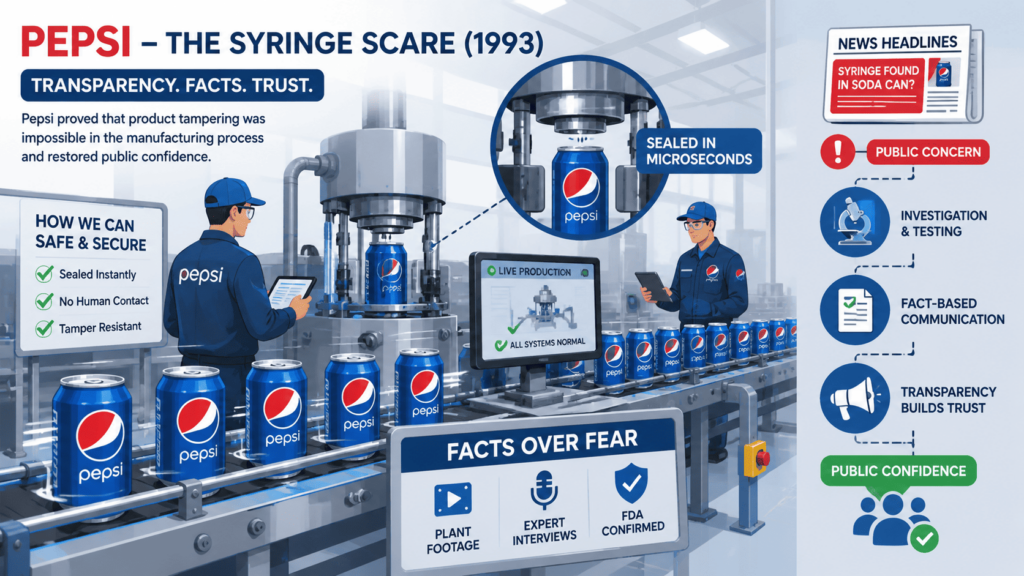
It started with one guy in Washington state. He said he found a syringe in his can of Diet Pepsi in 1993. News channels ran the story. Pepsi’s choice was strange. They didn’t issue a recall. Instead, they showed people how soda cans are made. They broadcast video from inside their bottling plants.
The cans move fast, they’re sealed instantly. The footage proved you couldn’t put a syringe inside during manufacturing.
The FDA confirmed it was a hoax. Pepsi’s CEO went on TV, explaining how the machines work. They used facts to fight a rumor.
Sales didn’t really suffer. The whole thing died down in about two weeks. Pepsi’s playbook was different. They didn’t panic. They just proved the story was impossible.
3. Toyota – The Sudden Acceleration Recall (2009-2010)
Toyota’s cars were supposed to be perfect. Then stories came out about Camrys and Priuses speeding up on their own. A poorly designed floor mat and a sticky accelerator pedal were the real reasons.
People died because of it. Toyota was slow to react. That silence made everyone angrier.
Finally, they recalled 9 million cars. Akio Toyoda, the company’s top boss, apologized on camera. He then flew to Washington and answered questions from Congress, which was not friendly.
Toyota added new safety systems, like a brake override, and checked every car more carefully. Starting late hurt them badly.
But spending billions to find and fix every single problem showed they were serious. It’s a case about cost. The cost of waiting, and the even bigger cost of making things right.
4. Samsung – Galaxy Note 7 Battery Fires (2016)
Remember the phone that kept exploding? That was Samsung's Galaxy Note 7. It wasn't just a few faulty units. Photos and videos of smoking, melted phones were everywhere online.
Samsung's initial recall was too small. When the replacement phones also started overheating, they had no choice. They recalled every single Note 7 on the planet and permanently ended production.
The financial loss was staggering, estimated in the billions. To win back trust, they offered full refunds or exchanges for any other phone. More importantly, they completely overhauled how they test batteries, adding multiple new safety checks. They were painfully public about this new process.
It was a textbook example of how to fail, and then recover. The crisis was entirely their fault, but their response was so fast and comprehensive that it stopped the brand from collapsing. People saw a company willing to burn money to fix its mistake.
5. McDonald’s – Pink Slime Controversy (2012)
"Pink slime" wasn't a food safety issue, it was a perception nightmare. The term, for a type of lean beef trimmings, went viral. Even though the product was legal and safe, the imagery was toxic for a fast-food giant.
McDonald's didn't argue with facts. They changed the conversation. They launched a campaign where anyone could ask them anything about their food, and they'd post the answer online. They took journalists and moms on video tours of their meat suppliers. At the same time, they quietly told suppliers to stop sending them the ingredient.
The move was smart. By becoming radically transparent, they drained the drama from the story. The controversy faded because there was nothing left to hide. It showed that in the social media age, the best defense is often complete visibility.
6. Facebook – Cambridge Analytica Data Scandal (2018)
This was the moment Facebook's data practices became a global scandal. We learned that a political firm, Cambridge Analytica, harvested information from millions of profiles through a personality quiz. That data was used to target voters, all without user consent.
The public and political reaction was fierce. Mark Zuckerberg was hauled before Congress for hours of questioning. Facebook's stock plunged. In response, the platform shut down thousands of old data-hungry apps, put new limits on what developers could access, and finally made privacy settings somewhat easier to find.
The damage was deep and lasting. It sparked government investigations, massive fines, and a wave of new privacy regulations in Europe and the U.S. User growth slowed as people started deleting the app. The scandal permanently shifted Facebook from a cool tech company to a powerful entity people viewed with deep suspicion and skepticism.
7. Sony – PlayStation Network Hack (2011)
Back in 2011, someone broke into Sony's PlayStation servers. They didn't just get in,they took everything. Names, passwords, and credit card details for 77 million people were exposed. Sony knew about it for days before saying a word. That silence made the whole thing worse.
The company finally shut down PSN for 23 days straight. They had to rebuild their security systems completely. To apologize, they gave away free games and offered identity theft protection.
It was a huge, expensive mess that started with bad communication. In the end, the network came back more secure, but Sony learned the hard way that you have to tell people immediately when their data is stolen.
8. Zoom – Privacy and Security Issues (2020)
Zoom became the default meeting app overnight when COVID hit. Almost as fast, its security flaws showed up. Strangers kept crashing private calls, a problem everyone called "Zoombombing."
Reporters found Zoom was sending some data through China and its "end-to-end encryption" wasn't really end-to-end.
The company made a hard pivot. They announced a 90-day feature freeze,no new bells or whistles, just security work. They hired outside experts, fixed the encryption, and added waiting rooms and host controls.
CEO Eric Yuan did a public mea culpa, admitting they'd built Zoom for business, not for the whole world. People stuck with them because the fixes were real and visible, not just promises.
9. Twitter – High-Profile Account Hacks (2020)
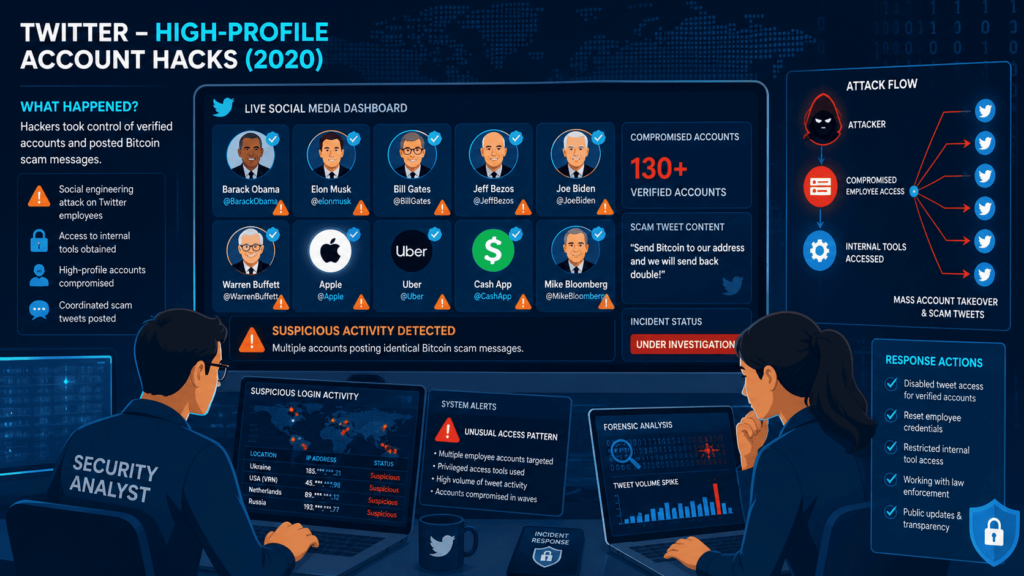
On July 15, 2020, the Twitter accounts of Obama, Musk, Gates, and dozens of other celebrities started posting the same message: "Send Bitcoin here and I'll send back double."
It wasn't a joke. Hackers had tricked Twitter employees into giving up internal tools.
For hours, Twitter was in chaos. The company disabled tweeting for all verified accounts. Engineers worked through the night, posting updates from the company account as they figured it out.
They later said the hackers had called employees, pretending to be IT support. It was a simple con that almost broke the platform.
Afterwards, Twitter limited internal system access and added more safeguards. The hack proved that even tech giants can fall for old-fashioned tricks.
10. Apple – Batterygate Controversy (2017)
iPhone users noticed their older phones were getting sluggish. Tech tests confirmed it, Apple was deliberately slowing down phones with worn-out batteries through software updates. The company's reasoning was technical: it prevented sudden shutdowns. But they never told anyone they were doing it.
The reaction was instant outrage. Headlines called it "planned obsolescence." Lawsuits piled up. Apple's initial statement was a defensive engineering explanation that satisfied nobody.
A month later, they apologized properly. They slashed battery replacement costs to $29 and added a "Battery Health" menu so users could see if their phone was being slowed. The scandal cost them nearly half a billion dollars in settlements. All of it could have been avoided with a single, clear disclosure in the update notes
11. Chipotle – E. Coli Outbreak (2015-2016)
Customers were getting violently ill. Health officials traced the source back to Chipotle restaurants. Over several months, E. coli outbreaks popped up in multiple states, linked to the chain. People were scared. Sales crashed.
Chipotle's response was total. They closed dozens of locations connected to the outbreaks. They threw out their old food safety playbook and wrote a new, much stricter one. Their marketing shifted hard, from "food with integrity" to ads detailing their new safety procedures.
The CEO did the media rounds, taking direct responsibility. They even created a fund for employees who lost wages when stores shut down.
It was a near-fatal hit to their brand. But their very public, very expensive overhaul of their entire system started to work. Trust is slow to rebuild, but they did the work.
The lesson wasn't subtle: when your food makes people sick, transparency and drastic action aren't just good PR, they're the only way to survive.
12. KFC – UK Chicken Shortage (2018)
KFC restaurants in the UK ran out of chicken. It sounds like a joke. It wasn't. A switch to a new delivery partner failed spectacularly in February 2018, leaving over 700 restaurants with empty kitchens. Shutters came down.
Their apology is now famous. A full-page newspaper ad showed their iconic bucket. The letters on it were rearranged to spell "FCK." The copy was blunt: "A chicken restaurant without any chicken. It's not ideal." They were funny, honest, and kept customers updated almost hourly on social media as they scrambled to fix the supply chain.
Public anger mostly turned into sympathetic laughter. The crisis highlighted a truth: a humble, human apology that acknowledges the sheer absurdity of your failure can disarm criticism faster than any corporate statement.
13. Nestlé – Maggi Noodles Ban in India (2015)
Maggi instant noodles were a cultural institution in India. Then, state regulators said lab tests found unsafe levels of lead and MSG in the product. The national government imposed a total ban, stripping every packet from store shelves nationwide.
Nestlé dug in its heels. They fiercely denied the allegations, questioning the testing methods. This defiance lasted weeks while public outrage grew. Finally, under immense pressure, they executed a massive recall, destroying roughly 400 million packets.
They engaged in a protracted battle with regulators, conducted their own tests, and after six months, relaunched Maggi with a heavy focus on "new, improved quality."
The financial loss was enormous. The reputational damage was deeper. Their initial combative stance made the comeback much harder. It became a case study in a global giant misreading a local crisis: fighting the government and dismissing consumer fear is a losing strategy.
14. Coca-Cola – Belgian Contamination Crisis (1999)
It began with schoolchildren in Belgium feeling sick after drinking Coke. Reports of nausea and headaches multiplied until over 100 people were affected. In June 1999, the Belgian government took the extreme step of banning all Coca-Cola products.
Coke's initial reaction was widely seen as arrogant and slow. Company statements downplayed the illnesses, suggesting bad carbon dioxide or "odd smells" might be to blame. This dismissal, as the ban spread to other countries, fueled a media firestorm.
After a critical week of delay, the company finally ordered a massive recall of 17 million cases. The CEO traveled to Belgium to issue a public, televised apology.
The week of hesitation turned a containable incident into a full-blown international crisis. They recovered, but the episode is a permanent stain on their record, a masterclass in how not to respond: never tell your customers their illness is in their head.
15. Starbucks – Racial Bias Incident (2018)
It started in a Philadelphia Starbucks. Two Black men were waiting for a friend. An employee called the police because they hadn't ordered anything. Officers arrived and arrested them. Another customer filmed it. That video hit the internet, and people were livid.
Starbucks got slammed. The CEO, Kevin Johnson, flew to Philly to apologize to the men in person. Then the company did something unusual. They closed every corporate-owned Starbucks in America for four hours on a Tuesday afternoon.
Over 175,000 employees went through a mandatory training program on racial bias. The company also rewrote its policy, explicitly allowing people to be in stores without making a purchase.
The whole episode was a crash course in modern public outrage. A single store's mistake, caught on camera, can blow up into a national crisis. Starbucks' fix was expensive and disruptive, which was probably the point. It showed they were taking it seriously.
16. Volkswagen – Emissions Scandal (2015)
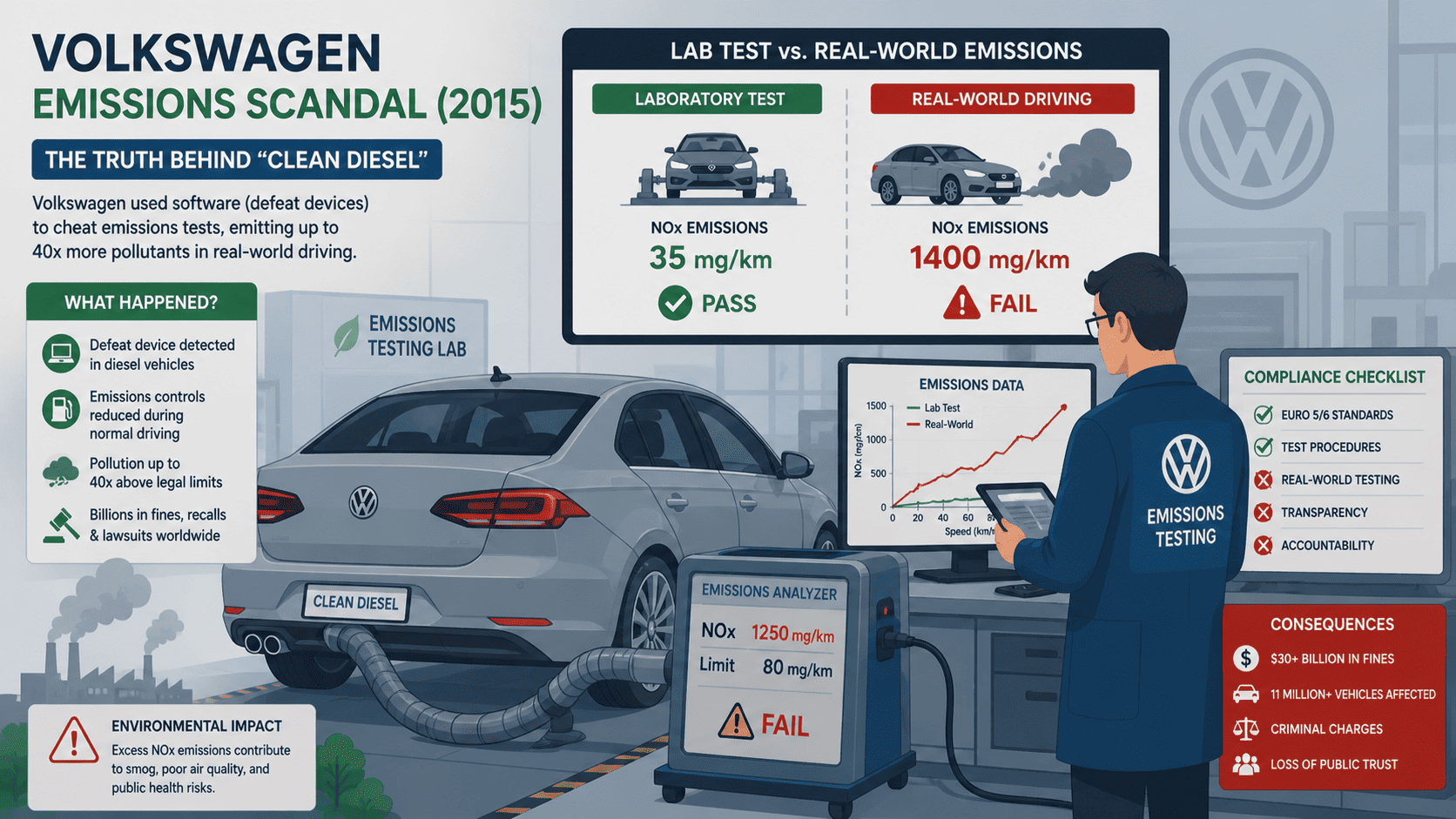
They sold millions of "clean diesel" cars. But the cars weren't clean. Engineers had installed illegal software, a "defeat device," that cheated on emissions tests. During testing, the car's pollution controls ran fully.
On the road, they dialed back, letting the cars emit up to 40 times the legal limit of nitrogen oxides.
The scheme unraveled when independent researchers at West Virginia University tested the cars in real-world conditions. They found the huge discrepancy and alerted regulators. Volkswagen's house of cards collapsed.
The CEO resigned, the stock plunged, and the company faced criminal charges. The final bill for fines, buybacks, and settlements topped $30 billion.
Volkswagen's path back was to go all-in on electric cars, a strategy born of pure necessity. The scandal wasn't just a recall; it was an admission of systemic fraud. Recovering from that requires more than new products, it requires a whole new identity.
17. Boeing – 737 MAX Crashes (2018-2019)
The Boeing 737 MAX was supposed to be a fuel-efficient update to a classic plane. But Boeing added a new automated system, MCAS, to handle the plane's changed aerodynamics.
They didn't tell pilots much about it. When a single sensor failed on Lion Air Flight 610, MCAS repeatedly pushed the plane's nose down. The pilots didn't know how to stop it. The plane crashed into the Java Sea, killing 189 people.
Five months later, the same thing happened to Ethiopian Airlines Flight 302. Another 157 people died. It was clear this was a design flaw, not pilot error. Boeing's initial statements were defensive, focusing on the pilots' actions.
Global aviation authorities didn't buy it. They grounded every 737 MAX worldwide, a humiliating first for an American-made jet.
Boeing eventually fired its CEO, halted production, and spent two years fixing the software and retraining pilots. The crashes revealed a culture where cost-cutting and schedule pressure had eroded safety checks. For an aerospace titan, it was a devastating self-inflicted wound. Trust in the MAX, and in Boeing, is something they're still rebuilding, flight by flight.
18. BP – Deepwater Horizon Oil Spill (2010)
The Deepwater Horizon rig was drilling an ultra-deep well called Macondo. On the night of April 20, a surge of methane gas shot up the drill pipe. It ignited, causing a massive explosion. Eleven workers died. The rig sank two days later. The broken wellhead on the seafloor, a mile down, began gushing oil.
For 87 days, engineers tried everything to cap it. Millions of barrels of oil spread across the Gulf, coating beaches from Louisiana to Florida.
BP's CEO, Tony Hayward, made things worse. He seemed detached, complaining about the media and famously saying, "I'd like my life back." The comment was a gift to late-night comedians and a slap in the face to Gulf Coast residents watching their livelihoods get destroyed.
The cleanup was a monumental, messy operation. BP's final cost exceeded $65 billion. The spill led to a moratorium on deepwater drilling and a total overhaul of federal regulations. For BP, the disaster was a lesson in physics and public relations. You can't hide an oil slick the size of a state, and you can't talk your way out of one with tone-deaf comments.
19. United Airlines – Passenger Removal Incident (2017)
United Flight 3411 was ready to go from Chicago to Louisville. Then the gate agent announced they needed four volunteers to give up their seats for United crew members. The offer went up to $800. No one took it. So United invoked its rules to involuntarily bump passengers.
They picked four people. One was Dr. David Dao. He refused, saying he was a doctor and had to see patients. The situation escalated. Airport security officers boarded the plane. They wrestled the 69-year-old man from his window seat, dragging him down the aisle as his glasses got knocked off and his face smacked an armrest.
Passengers' phones were out. The videos were online before the plane even took off. United's initial response was a masterclass in what not to do. CEO Oscar Munoz's first statement called it an "upsetting event" and backed his employees.
He later called Dr. Dao "disruptive and belligerent." The backlash was instant and brutal. Memes flooded social media, news channels played the video on loop, and politicians condemned the airline.
Within two days, Munoz was in full retreat. He issued a new apology, calling it "truly horrific." United reached a private settlement with Dr. Dao, reportedly for millions. The airline also changed its policy, promising to never use law enforcement to remove a boarded passenger over a seating issue.
The incident proved a simple rule: if your crisis is captured on video, your response time is measured in minutes, not days. And legalistic corporate-speak just pours gasoline on the fire.
20. Toyota – Brake Failure Recall (2010)
Toyota was still reeling from the sudden acceleration scandal when a new problem surfaced. This one involved the Prius hybrid. Drivers said the brakes would occasionally fail, a terrifying prospect.
Toyota's first instinct was to minimize the issue. They called it an "inconsistency" that most drivers wouldn't experience. That stance collapsed under the weight of consumer anger and a growing investigation by U.S. safety officials. Forced into action, Toyota recalled millions of vehicles. They also retrained technicians and began sending clearer, more frequent updates to owners.
The delay in responding cost Toyota dearly in public trust. What helped them recover was a years-long, visible focus on safety protocols and admitting mistakes. It’s a basic rule: if your product might hurt someone, you don’t get to debate the odds. You fix it.
21. Johnson & Johnson – Opioid Lawsuit (2019)

In 2019, a state court ruled that Johnson & Johnson played a key role in creating the opioid crisis. The judge said the company's marketing downplayed addiction risks and overstated benefits. The fine was $572 million.
Johnson & Johnson’s strategy was notable. Alongside legal appeals, they publicly highlighted their century-old credo on patient care.
They funded grants for addiction treatment centers and promoted research on non-opioid painkillers. They tried to pivot from villain to problem-solver.
The verdict was a permanent stain. But by investing in the solution, they hoped to rebuild some goodwill over time.
22. Nike – Colin Kaepernick Ad Controversy (2018)
When Nike made Colin Kaepernick the face of a campaign, they knew exactly what they were doing. Kaepernick was polarizing, famous for kneeling during the national anthem to protest police brutality.
The reaction was fierce. Critics called for a boycott, and viral videos showed Nike gear being destroyed. Nike didn’t apologize or pull the ads. They leaned in, framing the controversy as a commitment to "belief." Then their sales figures came out. Revenue jumped, especially with younger buyers. The brand’s identity got sharper.
Nike’s crisis wasn’t really a crisis. It was a calculated bet on their core audience, and it paid off.
23. Intel – Pentium Chip Flaw (1994)
In 1994, a math professor found a flaw in Intel’s Pentium chip. It caused a rounding error in very specific calculations. Intel’s response was famously dismissive. A company spokesman said the average spreadsheet user would only encounter the mistake once every 27,000 years.
Customers and computer magazines were furious. After weeks of terrible press, Intel caved. They offered a no-questions-asked replacement for any affected chip. Customer service policies were rewritten.
Intel’s mistake was treating it like a minor math issue instead of a broken promise. They learned that when your chip fails, you replace it. You don’t give people a statistics lesson.
24. Taco Bell – Fake Beef Lawsuit (2011)
A 2011 lawsuit accused Taco Bell of fraud. It claimed the "seasoned beef" was mostly filler, less than 35% real beef. For a fast-food chain, that’s an existential threat. Taco Bell responded with pure aggression.
They ran full-page ads with a bold headline: "Thank you for suing us." The ad then broke down the beef recipe ingredient by ingredient. They challenged the lawsuit’s facts directly in public, not just in court.
The combination of transparency and legal pushback worked. Sales stabilized. Taco Bell showed that sometimes you fight a fire with gasoline.
25. Airbnb – Racial Discrimination Allegations (2016)
For years, Black travelers posted stories about being rejected by Airbnb hosts. By 2016, it was a full-blown scandal. Airbnb’s early responses were vague and defensive, which made users angrier. The turning point came with concrete changes.
They introduced a new community commitment requiring hosts to agree to anti-discrimination terms. They launched the "Open Doors" program, providing instant rebooking for anyone discriminated against. Perhaps most significantly, they redesigned the booking process to emphasize names and reviews, not guest photos.
Airbnb’s crisis forced a system-wide change. They stopped making excuses and started rebuilding their platform.
Lessons from the Best and Worst Crisis Responses
Credits: Transform Comms
First, Johnson & Johnson in 1982. Someone had put cyanide in Tylenol capsules, and people died. The company's leaders didn't hesitate. They pulled every bottle of Tylenol from shelves across the entire country.
They went on TV to warn people. They didn't try to save money or protect their brand image first. They protected their customers, even though it cost them over $100 million. That's why people still use Tylenol today.
According to RUDN Journal of Studies in Literature and Journalism,
"Crisis is the acid test of PR where public relations has to save the image and standing of the company in every hour of distress." - RUDN Journal of Studies in Literature and Journalism
Then, United Airlines in 2017. You probably remember the video, a passenger being dragged off a flight. The CEO's first statement was an email to employees, saying the passenger was "disruptive."
He didn't apologize to the passenger publicly. That video spread everywhere, and the anger was instant. United's stock dropped. Their apology, which came later, felt forced. People didn't believe they really cared.
The difference is obvious. When something terrible happens, people don't want a company to be slow or to sound like a lawyer.
They want action, an honest "we messed up," and a sign that the company understands how bad it is. Johnson & Johnson did that. United didn't. Getting trust back isn't about a perfect statement. It's about proving you'll actually do things differently next time.
Steps to Create a Crisis Management Plan for Your Business
Most guides make this sound like a corporate checklist. It’s not. It’s about not getting caught flat-footed when everything goes sideways.
Think about what keeps you up at night. Is it a key employee leaving? A supplier going bankrupt? A bad review blowing up online? Write those down. Those are your real starting points.
You need a team, but keep it small. The CEO, your head of communications, maybe your operations lead. Everyone else gets instructions, not a seat at the table. Speed matters more than committees.
For communication, draft two things right now: a short internal announcement and a public statement. Have them ready in a document you can find in the middle of the night.
A clear crisis communication strategy ensures your team delivers consistent messages when pressure is highest. When panic hits, you won’t be thinking clearly enough to write from scratch.
Forget fancy training seminars. Once a quarter, grab your team and walk through a “what if.” What if our website goes down during a product launch?
What if a delivery truck is in an accident? Talk it out for 30 minutes. You’ll spot problems you never considered.
After something happens, and something will, gather everyone and ask one question: “What would we do differently next time?” Don’t assign blame, just fix the plan.
A good crisis plan isn’t a binder on a shelf. It’s the muscle memory your company needs when things get bad. Build that now, while the sun is still shining.
Crisis Management Tools and Resources
When an emergency hits, good tools are your best backup. They help you act quickly and keep things from spiraling.
Tool Category
Example Tools
Primary Function
Benefit During a Crisis
Social Media Monitoring
Brandwatch, Mention
Track online conversations and sentiment
Detect problems early before they escalate
Media Monitoring
Meltwater, Cision
Monitor news coverage and journalist activity
Helps manage press relations and messaging
Press Release Distribution
Prowly, PressPage
Publish official announcements quickly
Ensures accurate information reaches media fast
AI Sentiment Analysis
Sprinklr
Analyze public sentiment across digital channels
Identifies reputation risks in real time
Crisis Planning Resources
FEMA Emergency Planning Guides
Provide crisis preparedness frameworks
Helps organizations build structured response plans
See What People Are Saying Online
Watch for trouble on social media. Brandwatch tracks how people feel about your company in real time. Mention sends alerts as soon as a new problem pops up. Many teams rely on social listening for customer insights to spot complaints early and understand how public sentiment around a brand is shifting before a situation escalates.
Talk to the Press Without Confusion
You need a clear line to reporters. Meltwater handles media monitoring and social posts together. Cision focuses on press relationships and sending out your statements. Many communications teams rely on media monitoring tools to track breaking coverage and measure how quickly stories spread across news outlets and digital platforms.
Get Your News Out Fast
Speed is everything. Prowly lets you fire off press releases and official updates immediately. PressPage organizes all your press contacts and materials.
Let AI Spot the Next Problem
Tools like Sprinklr analyze social media chatter to measure public mood. It can show you where anger is building before it explodes.
Check the Free Government Plans
Sometimes the best advice is free. FEMA’s Emergency Planning Guides lay out basic, solid steps for getting ready.
These tools won't stop a crisis. They just make sure you're not scrambling when it arrives.
FAQ
What can we learn from PR Crisis Management Examples in History?
PR Crisis Management Examples in History show how organizations respond when reputation damage threatens public trust. These cases demonstrate the value of fast crisis response, clear crisis communications, and responsible public relations decisions.
They also show how media monitoring and public sentiment influence outcomes. Studying these situations helps organizations build stronger crisis management strategies and avoid repeating common mistakes.
How does social media change modern crisis management strategies?
Social media has changed crisis management because information spreads quickly across the digital landscape. A small mistake can turn into a major PR crisis or social media backlash within hours.
Organizations must monitor digital media, respond with accurate crisis communications, and address public sentiment clearly. Effective reputation monitoring helps prevent misinformation and reduces the risk of serious reputation damage.
Why is a crisis communication plan important for reputation management?
A crisis communication plan prepares organizations to respond quickly during a public relations crisis management situation. The plan defines communication methods, identifies responsible teams, and outlines how to deliver a clear press release or official statement.
With structured crisis communications and strong media monitoring, organizations can protect brand perception, control misinformation, and maintain public trust during difficult situations.
How do product safety issues lead to major PR disasters?
Product safety problems can quickly trigger PR disasters when they threaten customer safety or public safety. Issues such as product defects, food contamination, or food safety failures often require a product recall and transparent crisis communications.
When organizations delay their crisis response, public sentiment often becomes negative. Clear public relations messaging helps reduce reputation damage and restore confidence.
How can organizations rebuild public trust after a PR crisis?
Organizations rebuild public trust after a PR crisis by showing accountability and making visible improvements. Leaders must communicate openly, correct safety risks, and strengthen employee training and reputation monitoring.
Consistent crisis communications help address public sentiment and clarify the steps taken to prevent future problems. Over time, responsible crisis management actions can restore credibility and improve brand perception.
Stay Ready When the Next Crisis Hits
When a crisis breaks online, it moves fast and it hits your brand where it hurts most. One bad post can spread in minutes, and suddenly you're dealing with angry comments, confused customers, and pressure to respond. It’s stressful, and if your team isn’t ready, things can spiral quickly.
A simple way to stay ahead is using tools that help you react faster and communicate clearly when it matters most. Platforms like NewswireJet make it easier to push accurate updates and control the narrative before rumors spread.
Related Articles
- /social-listening-unlocking-customer-insights-for-your-brand/
- /best-media-monitoring-tools-for-pr-professionals/
- /what-is-crisis-communication-key-strategies-and-tips/
References
- https://www.ou.edu/deptcomm/dodjcc/groups/02C2/Johnson%20&%20Johnson.htm
- https://journals.rudn.ru/literary-criticism/article/view/31333