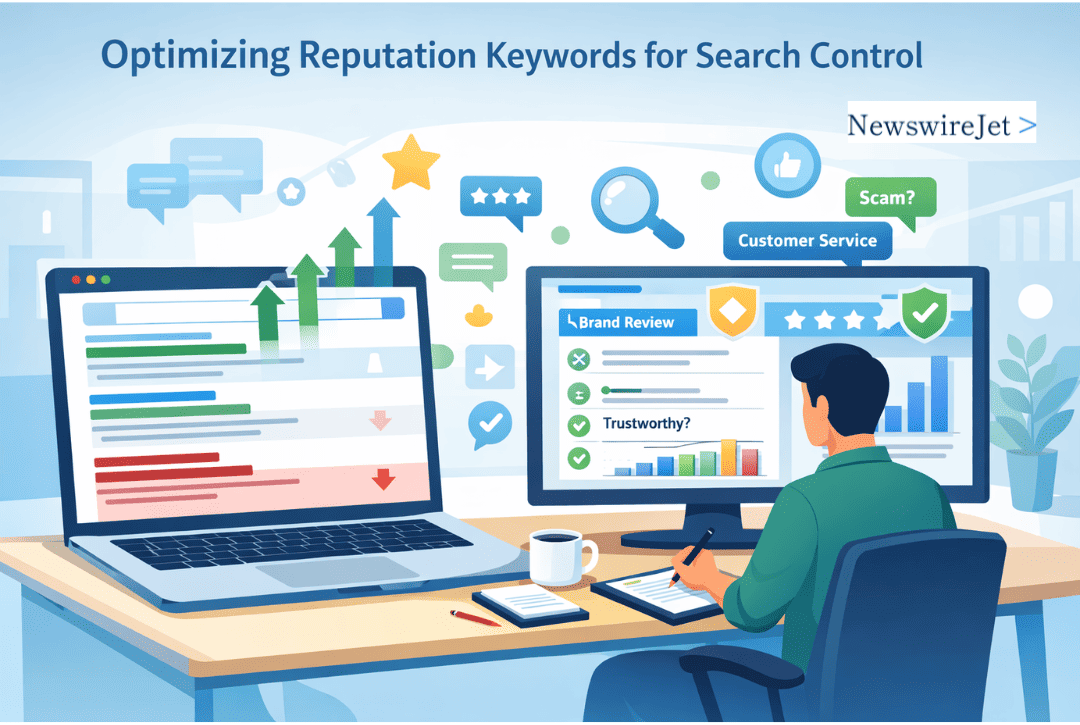
Forget ranking for "best coffee maker." The search that really matters is "is [your brand] coffee maker reliable?" Google's 2025 algorithms weigh trustworthiness (4% factor) and engagement from branded queries like 'reviews' or 'scam’.
Every search that questions your trustworthiness, from "reviews" to "lawsuit," gets tallied. Your visibility depends on how you manage these conversations. SEO and public relations are now the same discipline.
You either guide the narrative with targeted content, or you let your critics do it for you. To see how a precise keyword strategy can reclaim your search results, keep reading.
Reputation Keyword Quick Wins
Optimizing reputation keywords works best when every part of your strategy supports stronger search visibility and long-term trust.
- We improve online reputation by targeting branded and sentiment driven keywords before negative content gains traction.
- We strengthen search engine optimization by aligning content, reviews, and keyword optimization for online reputation management with trust based search intent.
- We protect our online presence by monitoring search shifts and adjusting content around changing reputation signals.
Why Reputation Keywords Matter in Search
Think about how you look at a company. You probably don't just search "Acme Corp." You type "Acme Corp reviews" or "Acme Corp customer service." Maybe you add "complaints" or "scam." You're looking for clues about whether they're trustworthy.
According to ResearchGate,
"The study also highlights that SEO is not only important in increasing brand visibility but also in building consumer credibility and trust. The use of relevant keywords and the creation of quality content are considered key factors in influencing the ranking of web pages in search results, which directly affects consumers’ [perception]." - ResearchGate
Google says people often decide what to click right on the search page. They read the snippets. So, your search results are your first impression. It's a fast, public check of your reputation.
When bad reviews or negative news articles show up for those searches, people see them immediately. Trust can be lost before anyone visits your actual website. A study from BrightLocal found 87% of consumers read online reviews for a local business before deciding.
The most critical searches are your brand name paired with words like:
- reviews
- complaints
- customer service
- pricing
- legit or trustworthy
These searches tell you exactly what your potential customers are nervous about. They show you the questions you need to answer publicly, before someone even thinks about buying.
Finding the Right Reputation Keywords
Forget about keyword tools for a second. Think about the last time you looked up a company online. You probably didn't type "best accounting software," especially when doing online reputation management keyword research.
According to University of Surrey,
"Institutional rankings now incorporate keyword searches to identify research in new & developing fields, and keyword analysis enables institutions to identify unique research strengths. ... Keywords should be selected with discoverability and visibility in mind." - University of Surrey
You typed something specific, like "does [That Company] have hidden fees?" or "[That Company] customer service phone number real reviews."
That's the language you need to find. Most marketing plans ignore it. They target the big, generic terms everyone fights over.
Meanwhile, customers are in the search bar, typing out their frustrations and doubts in long, detailed sentences.
Those sentences are your roadmap. Google's free tools (Keyword Planner, Search Console) can show them to you. Look for phrases with your brand name plus words like "scam," "reliable," "alternative to," or "how to cancel."
These searches aren't about discovery. They're about trust, risk, and decision-making. Fewer companies try to rank for them, so it's easier to get seen. And when you do, the person clicking is already deep in their decision process.
Here's how to sort what you find.
| Type of Search | Example | The User's Mindset |
| Brand + Review | "Clayton Hardware trustpilot" | "I'm checking if this place is legit." |
| Brand + Problem | "Clayton Hardware broken delivery" | "Something went wrong. I need a fix or I'm complaining." |
| Brand vs. Brand | "Clayton vs. Bolt Tools" | "I've narrowed it down. Now I'm picking one." |
| Brand + Location | "Clayton Hardware downtown" | "I need this today, nearby." |
Don't just make a big list. Group the phrases by the customer's goal. Put all the "review" phrases together. All the "problem" phrases. All the "where to buy" phrases.
This does two things. First, you won't publish ten articles that all try to rank for the same vague term.
Second, Google starts to see your site as the go-to place for answers about your brand's reputation, not just a sales page. You're covering the whole conversation, not just the welcome message.
Optimizing Pages for Reputation Signals

Google needs to see your site as a reliable answer. It checks a few specific spots on a page: the headline title, the preview text in the search results, the subheadings inside the content, and how the information is laid out.
These pieces are the proof it uses to decide if your page is a good match for someone searching for your name.
Each page should have a single, core keyword. Write the page around that word. It's okay to use other related terms, but don't overdo it. Using the same phrase too many times makes the content sound fake. It can push your ranking down and cause readers to lose interest.
You can give Google extra, specific facts with schema markup. This is a bit of code that tells it things like your average customer rating or your service location.
The benefit is a better-looking search result, which might show star ratings or your phone number right there.
Work on these parts for every page:
- The title tag. Make it obvious: your company and what the page is about.
- The meta description. Write a helpful, constructive preview.
- An FAQ block. Provide direct, confidence-building answers.
- Review snippets. If you have testimonials, set them up to be prominent.
This makes your pages more visible without forcing keywords everywhere.
Getting a high search ranking is only the first step. If the page itself is confusing, unattractive, or slow to load, visitors won't stay.
They'll doubt your credibility, even if you're number one on Google. The real win is ranking well while also having a site that people find genuinely easy and useful to use.
Using Reviews as Keyword Assets

Customer reviews are powerful for SEO because they're written in plain language. People describe what they did, what they bought, or the service they got. Those are the exact phrases they'll type into Google later.
When those words appear in your reviews, Google takes notice. Your Business Profile listing often uses them to decide where you show up in local search results.
New reviews matter more than old ones. Recent reviews boost trust and local AI rankings more than older ones.
You should ask for reviews regularly. Don't just focus on Google or Yelp. Figure out where your customers are already talking, maybe it's a trade-specific site or a local directory.
Here’s what helps:
- Ask for detailed comments, not just stars.
- Encourage people to name the specific service they used.
- Respond to reviews using your brand’s natural voice and keywords.
- Look for patterns in the positive feedback you receive.
Your responses to reviews let you steer the public conversation. When you handle reviews well, you build trust and improve your visibility both locally and in broader search results.
Building Content That Pushes Down Negative Results

If you want to bury bad search results, write content that solves the actual problem. Google ranks pages that help people. So when a negative article pops up, don't ignore it. Create your own page that answers the criticism.
Do it clearly and honestly. Over months, that good page can start to outrank the bad one.
Promotional fluff doesn't work. What does? A real case study showing how you fixed a mistake. An FAQ that admits past issues and explains what changed. A leadership page with a genuine story, not just a title. People read this.
They link to it. Google notices. HubSpot says consistent publishers get 55% more web traffic. More pages in the index means more shots at ranking for something useful.
Some formats that help:
- A customer story (what went wrong, how you made it right)
- A trust page (security steps, warranty details, compliance info)
- An executive bio (their background, why they care, how to reach them)
- A community page (volunteer work, local partnerships)
This builds authority. It tells Google you're a real source. Link these pages together inside your site. It helps search bots figure out which pages are your most important ones.
Grouping content by topic
Don't scatter pages. Connect them. Make one main page about your company's reputation. Then make supporting pages for specific trust topics.
For example: a page on your data privacy steps, another on your supplier ethics, another on your charity work.
This shows Google you own the topic. Its systems now look at how ideas connect across your whole website, not just single pages.
That's key as AI summaries pull from sources they trust. These days, having deep, detailed content is as important as having a famous brand name.
Monitoring Reputation Keywords Over Time
Credits: Metics Media
Search results don't stay put. A customer leaves a one-star review tomorrow. A tweet gets shared a hundred times.
This is where a strong keyword strategy for online reputation management becomes essential.
A tweet gets shared a hundred times. A blog post mentions your company. Any of that can move you up or down the page. We use Google Alerts.
It emails me when my brand is mentioned anywhere. I also glance at Google Analytics once a week to see where my website traffic is coming from. It's about seeing the change before it becomes a real issue.
Check how many people are searching for your brand name each month. If you see a sudden jump in searches for things like "is [Your Brand] legit" or "[Your Brand] customer service number," that's a signal.
Often, that search volume increases weeks before you notice fewer sales. It's an early warning.
Watch these specific numbers. They don't lie:
- Your search ranking for your own name.
- The date of your most recent reviews. Old reviews aren't as impactful.
- Click-through rate. How many people see your link and actually click it?
- The overall sentiment in comments and reviews. Is it getting more negative?
Together, they paint a picture of trust. Are you building it, or losing it?
It's not just about content. Google's guidelines are clear: page experience matters. Core Web Vitals, which measure loading speed and responsiveness, are a confirmed ranking factor.
If your website is slow or glitchy on a phone, Google may show it lower, even for your own brand name. A bad site experience erodes trust just like a negative article.
All this tracking is pointless if you don't act. The goal is to see a negative sentiment trend and then fix whatever caused it. See your click-through rate drop? Maybe your page title needs work. The data on your screen is just information. Your response is what matters.
FAQ
How do reputation keywords influence search results?
Reputation keywords influence what people see when they search for a business or person online. These keywords help search engines connect your content with your online reputation.
When your pages include reputation keywords naturally, positive content can appear more often in search engine results. This approach can reduce the visibility of negative content and improve control over your online presence.
Can social media help reputation keywords rank better?
Social media can help reputation keywords rank better because social profiles often appear in search results. Active social media platforms can strengthen your online presence and give search engines more trusted content to index.
Regular posting, social media engagement, and consistent messaging can support reputation management. These actions can also help push negative search results lower in search engine results pages.
Why do negative search results stay visible longer?
Negative search results often stay visible because they attract attention and receive clicks from users. Search engines may treat this activity as a sign that the content matters.
Pages with strong domain authority can also remain in search engine results longer. Negative reviews on trusted review sites can continue ranking well without a strong reputation management SEO strategy.
Which SEO techniques support reputation management?
Several SEO techniques can support reputation management and improve search control. Useful methods include internal linking, structured data, schema markup, and clear meta descriptions.
Long-tail keywords can help target specific reputation keywords more naturally. Better page load speed, mobile-first indexing, and content creation can also improve search engine optimization and strengthen your digital reputation management efforts.
How can businesses track reputation keywords effectively?
Businesses can track reputation keywords by using Google Alerts, Google Analytics, and Google Search Console. These tools show how search results change over time. They also help identify negative content before it spreads.
Monitoring customer reviews, social media feeds, and review sites can provide a clearer view of your online reputation and support faster reputation repair decisions.
Build Trust Before People Even Click
When someone searches your brand, the results can shape trust before they ever visit your site. That's why reputation keywords matter.
Strong SEO reputation work helps you guide what people see, so your brand looks credible and easy to trust when they are ready to make a decision.
If you want a faster way to strengthen that visibility, NewswireJet can help put your brand in front of trusted media sources.
It gives you a simple way to support your reputation with a broader search presence that can keep working long after one campaign ends.
Related Articles
- /keyword-optimization-for-online-reputation-management/
- /online-reputation-management-keyword-research/
- /keyword-strategy-for-online-reputation-management/
References
- https://www.researchgate.net/publication/382953524_The_Effectiveness_Of_Search_Engine_Optimization_SEO_In_Marketing_A_Meta-Anlysis_Study
- https://www.surrey.ac.uk/sites/default/files/2022-02/keywords-guidance.pdf