Online Reputation Management is about making sure the right pages show up first when someone searches your brand. Most people never look past page one, so those first results carry a lot of weight. A clear keyword plan helps useful, accurate content stay visible while less helpful mentions fall lower.
Reviews, profiles, and articles all shape that first look. Over time, this keeps your presence steady across search and social platforms without trying to force the story. Keep reading to see how the right keywords can support trust and bring the right kind of attention.
What Matters Most in ORM Keyword Strategy
- We use keyword strategy to influence what appears first on search results pages and how a brand comes across
- Long-tail and reputation-based keywords help push down negative reviews and bring forward positive reviews
- A mix of social media, review sites, and web pages helps keep an online reputation steady
What is A Keyword Strategy for ORM And Why Does It Matter?
A keyword strategy for Online Reputation Management is about choosing the search terms tied to your brand and making sure the right pages show up first.
Most people type a name, scan a few results, and make a quick call. They do not dig deep. What they see at the top often sticks.
So the work is practical. Look at what already ranks. Fix what feels off. Add pages where nothing useful exists. Keep the message steady across your site, your profiles, and your reviews.
Searches about reviews or simple brand questions matter more than broad terms. They come from people who are already paying attention.
As noted by Wharton Executive Education
"Write an accurate, compelling, and keyword-rich description so your review site will pop up in search. Claim a vanity URL that features your business name on sites that allow this. Beyond review sites, you also want positive news about your business circulating online so if people search for your company, they’ll see it. You can get more positive blog mentions and news articles with a public relations strategy." - Wharton Executive Education
Key ORM keyword principles include:
- Branded keywords shape what appears when someone searches your name
- Reputational queries show where trust is weak or strong
- Long-tail keywords cover specific searches that do not show up often but still matter
- Showing up in more than one place helps keep your digital footprint consistent
What are The Core Keyword Categories in ORM?

ORM keywords fall into four groups. The names are simple, but they map to real behavior.
People search your name. They check reviews. They compare. Sometimes they ask very specific questions. Each step needs its own set of terms.
When something negative happens, search patterns can shift overnight. More people look for reviews, complaints, or updates. If there is no clear content for those searches, older or less helpful pages take over.
These keywords are used across your site, your Google Business profile, and review platforms. They also affect what shows up in local results.
In a recent analysis by Michigan State University
"Start by brainstorming any relevant topic. List core topics related to the unit's strengths and target audience. What does the unit do well? What should the unit be known for? Next, think like a member of the target audience. What questions might they search? How do these relate to the unit? These initial keywords become seed keywords. The unit's keyword list will grow from these 'seeds'." - Michigan State University
| Category | Intent | Difficulty | Impact |
| Branded | Navigational | Low | High |
| Reputational | Trust | Medium | Very High |
| Comparative | Decision | Medium | High |
| Long-tail | Specific | Low | Medium |
These categories include:
- Branded core keywords: what appears when your name is searched
- Reputational keywords: searches about reviews, complaints, or trust
- Comparative keywords: used when people weigh options
- Long-tail keywords: more detailed searches with lower volume
Together, they cover both the obvious searches and the quieter ones.
How Do We Build an ORM Keyword Strategy Step By Step?

Start with a simple search. Type your brand name and see what comes up. That page tells you more than any report, and it sets the base for keyword optimization across your brand presence.
Then look closer. Which results feel solid, and which ones do not? Are reviews easy to find? Is anything outdated or off?
After that, match keywords to pages. One main idea per page. No overlap. Keep it clean.
If something is missing, create it. If something is weak, fix it. This part takes time, but it is where most of the change happens.
Our process includes:
- Audit and discovery: check current results and note what is missing
- Keyword mapping: connect each term to a clear page
- Content creation: add pages that answer real questions and show real feedback
- Optimization: adjust pages so they hold their place over time
Done well, this builds a steady set of results. Nothing forced. Just a clearer, more reliable picture of the brand when people search for it.
How Can We Dominate SERPs for Reputation Keywords?
You do not need to own the whole page. You need enough of it that the first impression feels clear, especially when competing across reputation SERPs.
That usually means your site shows up, along with your social profiles, review pages, and a few outside mentions. When those sit near the top together, people stop there. They do not keep digging.
Most clicks land in the first few results. So the work stays focused on those spots. Not every page, not every keyword.
Different types of content help fill those positions. A service page might rank. So might a profile, a short video, or a review listing. It adds up.
Things also need upkeep. Pages slip if they sit too long without updates.
Our SERP approach includes:
- Website pages built around your name and common searches
- Social profiles that stay active, not abandoned
- Google Business Profile and listings that are complete
- Media mentions that are recent and consistent
If you hold several spots on page one, older or negative results tend to get pushed down. They are still there, just harder to find.
What Advanced ORM Keyword Tactics Actually Work in 2026?
Credits: StudioHawk dan Harry Sanders
Some of the most useful work now happens in small places.
Low-volume searches are one of them. These are the odd, specific phrases people type when they are unsure about something. They do not show up in most keyword tools, but they appear in real searches, and they often reveal gaps in your reputation SEO approach.
We group those terms and build simple pages around them. Nothing heavy. Just clear answers.
Another part is watching the tone. A few bad reviews close together can change how things look in search. Catching that early gives you time to respond before it spreads.
Search results are also shifting. AI summaries pull from pages that are easy to read and well structured. Pages with clear sections and review data tend to show up more often.
Our advanced tactics include:
- Grouping low-volume keywords into small, focused topics
- Watching sentiment through social listening tools
- Keeping pages clear so AI systems can read them without guesswork
- Adding review schema to help search engines place content correctly
None of this is dramatic. It is steady work that holds your position as search keeps changing.
What are The Biggest ORM Keyword Strategy Mistakes?
The same issues come up in most cases.
A lot of effort goes into the main website, while review pages and other sites are left alone. But when someone searches a brand, those outside pages are often right at the top.
Another problem is delay. A negative review sits for days, then weeks. More follow. By the time someone responds, the tone has already shifted.
Some pages do not help much either. They repeat the same lines, or say very little. Those pages rarely stay near the top.
Key mistakes include:
- Focusing only on branded keywords
- Ignoring review sites and other outside pages
- Letting negative reviews sit without a reply
- Treating SEO, PR, and legal as separate work
- Writing short, generic replies or having very few recent reviews
Fixing this is slow but clear. Pay attention to what shows up, and deal with it directly.
How Do We Monitor and Improve ORM Keyword Performance?
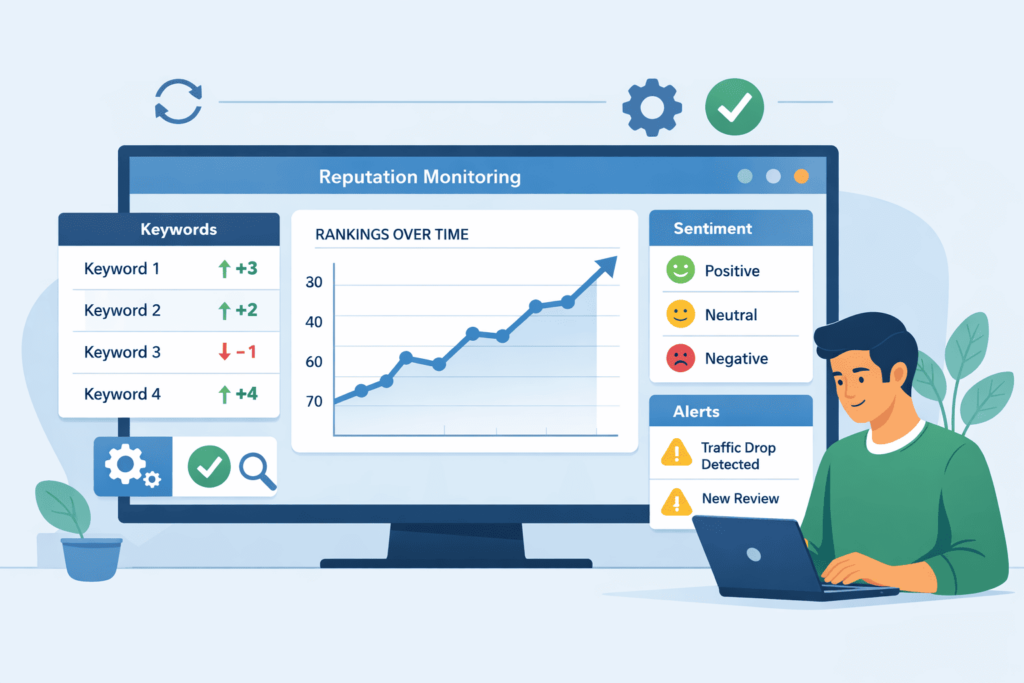
This work needs regular checks. Not constant, but often enough to notice changes.
Search your brand and see what appears. That alone shows a lot. Then look at reviews. Are they recent? Do they point to the same issue?
Tools help, but they are only part of it. Alerts can show new mentions. Analytics can show where people go. Reviews show what people think.
What matters is the pattern. One comment does not mean much. A steady trend does.
Our monitoring framework includes:
- Checking search results each week
- Looking at new reviews and how they read
- Reviewing traffic and behavior in analytics
- Updating pages when they start to drop
Replies matter here too. A clear, direct response does more than a long one. Over time, that steady tone helps shape how the brand is seen.
FAQ
What is the best way to start an online reputation strategy?
We start with keyword research to understand how people search for our brand and services. Then we review search engine results and study customer feedback. We also check review sites and social media profiles.
This process helps us build a clear content strategy. We focus on search engine optimization and strong web pages to improve our online reputation and search engine rankings.
How do we handle negative reviews without hurting our brand?
We respond quickly and remain calm in every situation. We thank people for their customer feedback and offer real solutions. Strong review management and thoughtful review responses help build trust.
We also encourage more positive reviews to create balance. This approach supports our brand reputation and shows care across social media sites and review websites.
How can social media help improve our brand reputation?
We stay active on social media channels and share useful and honest content. Social media marketing helps us reach more people, while social listening helps us understand opinions.
We respond to comments and join conversations on media platforms. This builds social proof and trust. Over time, our social media management strengthens our Online Reputation Management efforts.
Why are search engines important for reputation management?
Most people rely on search engines when they look for information. We use search engine optimization to improve our position on search engine results pages. We create helpful web pages, use branded keywords, and apply schema markup such as review schema.
These actions improve our Google search results, increase website traffic, and strengthen our digital footprint.
What tools help us track and improve our online reputation?
We use Google Alerts to track new mentions and media monitoring to follow coverage across media channels. Social listening tools help us understand conversations on social media.
Analytics software, including Google Analytics, shows website traffic and user behavior. We also review Google Search Console for search data. These tools support reputation measurement and guide better content optimization decisions.
Putting Your ORM Keyword Strategy Into Action
You already know how this works. People search, they scan, and they decide fast. When they look you up, do they see a story you shaped or one you left behind? Most people don’t scroll far. They trust what is on the first page. That first page becomes your reputation in real time.
So this is the work: show up, adjust, repeat. Not once, but until the page reflects what is true and current. If you ignore it, others define it for you. Start today. Search your name, fix one thing, then keep going. Build it with NewswireJet today now.
References
- https://executiveeducation.wharton.upenn.edu/thought-leadership/wharton-online-insights/small-business-online-reputation-management-tips/
- https://dxstudio.msu.edu/website-technology/seo/keywords
Related Articles