Written by Nell VH
If you're worried about your website suddenly losing traffic or getting hit with a wave of spammy links, you're not paranoid. That's negative SEO. It's when a competitor, or just some malicious actor, tries to sabotage your search rankings.
Google tries to filter this junk out automatically, but it's not perfect. For a smaller business, the damage can be real and fast.
The next sections cover the specific tactics used in these attacks and a straightforward plan to shield your site. Let's get into it.
Quick Reads: Negative SEO Warning Signs
Negative SEO tactics often create damage slowly, which makes early detection more important than many site owners expect.
- Negative SEO attacks often target backlinks, reviews, and technical vulnerabilities at the same time.
- Smaller websites usually experience ranking volatility faster because they have weaker authority signals.
- Early monitoring through Google Search Console and backlink tools can reduce recovery time significantly.
Threat Snapshot
Negative SEO is sabotage. It's when a competitor or bad actor tries to break your website's standing in Google by any means necessary. The methods are manipulative, meant to tank your rankings, choke your traffic, or erode trust.
Google updates its spam filters constantly. They're better at spotting these schemes than they were a few years ago.
But the attacks haven't stopped; they've just gotten more targeted. Smaller websites with less authority are the easiest victims. The whole operation can be automated cheaply, flooding a domain with bizarre, artificial signals.
The damage often shows up in a place you check regularly: your branded search. Look up your own business name.
You might find odd, low-quality pages ranking alongside yours, forums full of fake complaints, or entire articles copied verbatim onto other sites that may require content removal techniques before they cause deeper trust issues.
This social proof gets poisoned first. People lose trust before the algorithm officially demotes you.
For a small team, this is a nightmare. You're not monitoring backlink profiles and search console alerts every single day.
By the time you notice a dip in traffic or a weird report, the attack could have been running silently for a month. That's a lot of time for harm to accumulate.
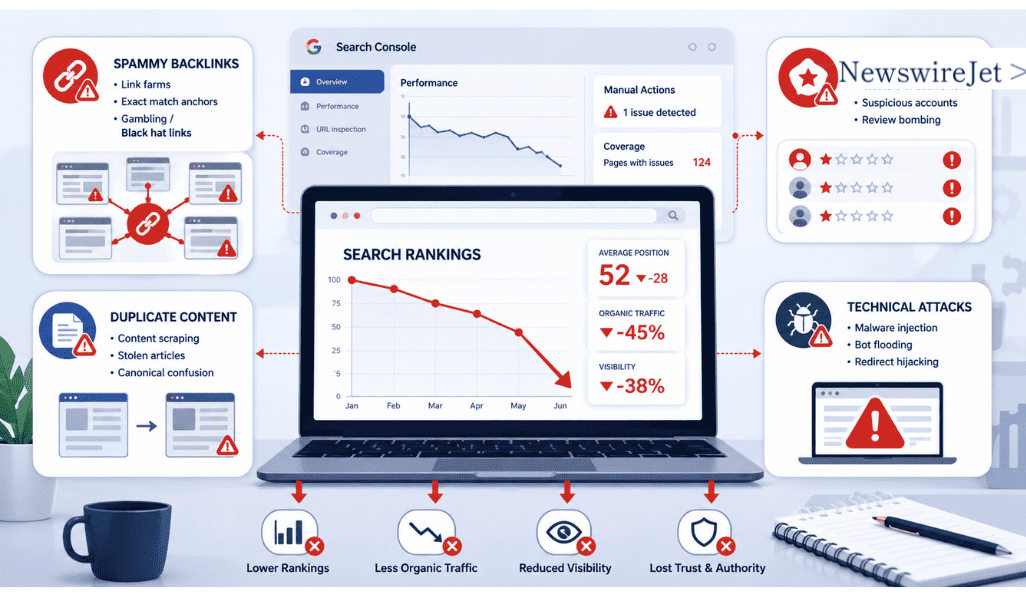
So what does it look like? Watch for these patterns together:
- An unnatural spike in backlinks from irrelevant or spammy websites.
- Your content duplicated on other domains you don't control.
- A cluster of negative reviews appearing simultaneously across platforms.
- Security warnings or "manual actions" reported in Google Search Console.
These signals usually arrive as a package. One problem, like spam links, might seem isolated.
But when you see duplicate content and fake reviews and security flags all at once, that's a coordinated strike, not a coincidence.
What Are Negative SEO Tactics?

Negative SEO is basically online sabotage. Someone tries to wreck your website's Google ranking from the outside. You don't do anything wrong, they do.
According to ResearchGate,
"Negative SEO is a relatively new phenomenon whereby a third party applies SEO techniques that seek to exploit vulnerabilities in search engine ranking algorithms to negatively affect the ranking of a target website." - ResearchGate
This tactic gained prominence with Google's Penguin update on April 24, 2012, which started cracking down on spammy links.
Some clever, and not-so-nice, folks realized they could turn that weapon against other websites. They'd build those spammy links pointing to a competitor, hoping Google would punish the target instead.
Here's the simple breakdown: Bad SEO is when you mess up your own site. Negative SEO is when someone else tries to make it look like you messed up. They're faking the evidence.
What does it look like? For a small local business, it might be a bunch of fake listings with the wrong phone number or address.
For a bigger site, it could be a sudden avalanche of low-quality links from sketchy websites, or having all your blog posts copied and pasted onto other domains. The goal is to trick Google's systems into thinking your site is breaking the rules.
Why bother? Usually, it's about competition. Someone wants to:
- Hurt a rival's reputation.
- Pollute their backlink profile.
- Get Google to manually review and possibly penalize them.
- Just stall their growth.
Some attacks are clumsy and easy to spot. Others are more subtle, designed to look real for as long as possible.
Which Toxic Backlink Schemes Cause the Most Damage?
The biggest complaint in SEO is still spam backlinks. It's easy to see why. A website can be bombarded with thousands of worthless links in a matter of days.
That kind of volume completely distorts the natural link picture.
Tools like Ahrefs have documented sites gaining thousands of suspicious links rapidly, such as 12,000+ in attack cases.. Every one of them from a suspicious source. That's not growth, it's an attack. It makes a clean link profile look fake.
This is done with bots. Automated systems generate links from abandoned online spaces: dead blogs, old forum accounts, expired domains.The anchor text is a giveaway, packed with obvious commercial keywords.
Links from questionable places are another headache. Gambling sites, adult content, hacked pages.
Search engines try to ignore them, but a persistent pattern can make a new site look guilty by association.
When you get hit, you'll notice a few things:
- A flood of links from forum profiles.
- Anchor text that matches a keyword you're targeting exactly.
- Links from spammy domains in a foreign language.
- Sitewide links hidden in a page footer.
Here’s a quick look at the usual suspects:
Tactic
Risk Level
Common Source
Link farms
High
Paid spam networks
Exact match anchors
Medium
Automated tools
Adult or gambling links
High
Black hat campaigns
The real issue is the pattern, not a single link. A huge, unnatural spike in links casts doubt on everything, even your legitimate work.
How Does Content Scraping Hurt Rankings?

They copy your site's content and paste it onto their own. For you, it's theft. For Google, it's a confusing mess. The search engine now sees two identical pages and has to figure out which one is the original owner. That process isn't perfect, and it can hurt your site.
According to Frontiers in Sociology,
"While there has been much theoretical speculation around the role of SEO techniques in boosting the ranking appearance of a website, few empirical studies have been undertaken to understand the extent to which SEO techniques are used to promote visibility online... [or] which actors employ SEO techniques to foster the circulation of their ideas and agendas around hot topics." - Frontiers in Sociology
Duplicate content confuses search engines, diluting crawl budget as bots index copies instead of originals; tools like Copyscape help detect this. The bots are busy reading the same article on ten different sites instead of discovering new ones.
The worst part is how fast it happens. A scraper can grab your new blog post and have it live on another domain in minutes.
If Google finds that copy first, even briefly, it muddies the water. It takes time for the system to sort out the true source, and while it's figuring things out, your page might not get full credit.
This also breaks the canonical tag, which is supposed to tell Google, "Hey, this is the main version of the page." Scrapers often copy that tag too, so it ends up pointing to the wrong place.
Common types of content scraping include:
- Lifting entire articles
- Stealing product descriptions
- Republishing RSS feeds automatically
- Copying page titles and meta descriptions
- Hotlinking to your images (using your bandwidth to display them)
Sometimes, it's more than just copying. It's used as a weapon. Someone might scrape your content and then point hundreds of spammy links at the stolen version.
This can turn your own work into an anchor that drags down your site's rankings in what's essentially SEO sabotage.
Can Fake Reviews Damage Local SEO?

Getting hit with a bunch of fake reviews can really mess up a local business. It's a fast way to lose trust, because let's be honest, almost everyone reads reviews before they decide to go somewhere or buy something. These attacks usually start on a business's Google listing.
What does it actually do? Imagine you wake up to ten new one-star reviews. Your business might still show up in searches, but people see that low star rating and just keep scrolling.
They don't click. When fewer people click, Google notices. Over time, your listing starts to disappear from the top spots.
How do people do it? Sometimes one person makes several fake accounts to post the exact same complaint on Google, Yelp, and Facebook. Other times, they'll also post about it on social media to make it seem like a bigger deal than it is.
You can usually tell the reviews are fake. Look for:
- A bunch of bad reviews posted all at once, like within a couple of hours.
- They all say basically the same thing.
- The reviewers have no history of ever buying from you.
- The accounts look empty or were just created.
You need to report this stuff fast. If those fake reviews sit there for weeks, they shape what people think about your business.
That bad reputation can stick around and hurt you way longer than your search ranking being a little lower for a few days.
What Technical Attacks Signal a Serious Negative SEO Campaign?
Let's talk about technical attacks. They're not just nuisances, they're deliberate attempts to break a website, usually through hacking or by flooding it with fake traffic until it buckles.
Why should you care about a slow site? Cloudflare's research is pretty blunt: a one-second delay in loading can cut your conversions by 7%.
That's a direct hit to your revenue. It's not just about search rankings anymore.
So, how do these attacks actually work? One method is to hide spam pages deep within your site's backend. Another is a brute-force approach: firing thousands of automated requests per second at your server.
This eats up all your bandwidth and cripples Google's ability to crawl your actual content. Sometimes, they go after your redirects. They'll change the settings so your visitors get sent to a scam page, but search engines keep trying to index your original, now-pointless, URL.
You'll know something's wrong if you see:
- Your server's workload inexplicably doubles.
- Pages you've never created show up in Google's index.
- A link says it goes one place, but you end up somewhere completely different.
- Your browser or security tools flag the site as dangerous.
- You or your users get repeatedly locked out of accounts.
Here’s a breakdown of common attacks:
The attack
The main result
The telltale sign
Malware injection
Your pages get dropped from search results.
You start getting security alerts in your dashboard.
Bot flooding
Your site becomes agonizingly slow.
Your server logs show a massive, sustained spike in CPU usage.
Redirect hijacking
Your organic traffic just vanishes.
The URL listed in Google search redirects to a foreign site.
At its core, this isn't an SEO problem. It's a security problem. If your site is vulnerable to these attacks, you have a hole in your defenses that needs patching, fast.
How Can We Detect Negative SEO Early?

The key to early detection is simple: watch for the weird stuff before it gets big.
Get in the habit of checking Google Search Console. Look for a strange jump in new backlinks, pages Google can't read, or content that's been duplicated.
Catching this early can prevent a ranking slide. A quick weekly look cuts your reaction time in half for most issues.
You also need to watch your traffic. In Google Analytics, pull up your referral sources. Compare them to your normal pattern. A sudden spike of visits from irrelevant or low-quality sites is a major warning sign, it often means a coordinated link attack is starting.
Listen for your brand name, too. A quick scan of social mentions and local review sites can reveal false complaints or negative chatter before it starts hurting your business locally.
A few routine checks help a lot:
- Review new backlinks each week.
- Search for copies of your main pages.
- Track where your brand is mentioned.
- Watch the Crawl Errors report.
- Check key review platforms.
Doing these things regularly is more effective than any single software platform. Consistency beats complexity.
How Should We Respond to a Negative SEO Attack?
Credits: Edward Sturm
When spam links or fake reviews hit your site, it's a setback. Recovery takes time, maybe 30 days, maybe 90. It depends on how bad the attack was and how quickly you start fixing it.
You need a plan, not a panic.
First, audit your backlinks. Look at every link pointing to your site. Find the suspicious ones: domains you've never heard of, links from irrelevant places, anything that looks like it was placed just to cause harm. Write down what you find.
If you find links that are clearly toxic, you can use Google's Disavow Tool. But only use it if you have proof. You upload a list of the bad domains. This tells Google to ignore them.
Then, secure your website. Turn on two-factor authentication. Update your CMS and all plugins. Scan for any malicious code. A vulnerable site keeps getting targeted.
For fake reviews, report them. Use the platform's official reporting system. Take screenshots first. Keep a record.
Now, build real trust. Don't just fight the bad stuff, add good stuff. Create useful content because negative content suppression often works better when stronger pages begin replacing harmful search visibility.
Reference authoritative sources, like the FTC (ftc.gov) for consumer issues or CISA (cisa.gov) for security guidance. This shows you're credible.
A structured response works better. Trying to fix every single problem as it pops up usually backfires. Focus on the main steps: the audit, the disavowal, locking down your site, reporting fakes, and publishing better resources. That's the path to recovery.
FAQ
How can we spot negative SEO attacks early?
Negative SEO attacks often begin with sudden spammy links, fake reviews, or unusual traffic patterns. We should monitor our backlink profile, search results, and referral sources on a regular schedule.
Google Search Console can reveal indexing issues and malicious links before rankings decline. Early monitoring helps us protect our online reputation and prevent larger search engine optimization problems from affecting the entire website.
Can spammy backlinks really lower our rankings?
Spammy backlinks can reduce trust when search engines detect unnatural anchor text or links from a link farm. A regular backlink audit helps us identify spam links that do not match our normal link profile.
When harmful patterns appear, we can disavow links that create risk. Reviewing spammy backlinks early helps protect website authority and preserve organic rank over time.
What should we do after content scraping happens?
Content scraping can create content duplication that confuses search engines about the original source. We should document copied pages, confirm the canonical tag is correct, and file a DMCA takedown notice when necessary.
The Digital Millennium Copyright Act can support copyright removal requests. Quick action helps protect high-quality content and maintain search visibility for the original site owner.
Can negative reviews affect local search visibility?
Negative reviews and fake positive reviews can influence online reviews and weaken local trust signals. Review bombing can damage online reputation and reduce visibility in local search results. We should monitor our Google Business Profile and social media profiles for suspicious activity.
A clear reputation management process helps us respond professionally and protect local search visibility from unfair attacks.
How do we protect a site from technical SEO sabotage?
Technical SEO sabotage can include malicious code, heavy crawling, or unauthorized access through a weak content management system. We should strengthen website security with two-factor authentication, DDoS protection, and a secure content delivery network.
Regular checks in Google Analytics and Google Search Console can reveal unusual changes. Fast action can prevent website ranking and page speed from suffering.
Stay Ahead Before Rankings Slip
When negative SEO hits, you usually notice it after traffic drops and trust starts to weaken. That delay can make recovery harder.
Consistent monitoring helps you catch harmful links, reputation issues, or technical problems before they start affecting the visibility you've already built, making suppressing negative content easier before rankings decline further.
Using it can give you a simple way to strengthen authority while keeping your brand visible in trusted media sources. It works as a practical next step if you want stronger protection without waiting for a ranking problem to become expensive.
Try to strengthen your brand visibility before negative SEO becomes harder to fix with Newswirejet.
Related Articles
- /negative-content-suppression-with-seo/
- /suppressing-negative-content-seo/
- /content-removal-techniques/
References
- https://www.researchgate.net/publication/280024484_A_Risk_Assessment_Method_for_Negative_SEO_Attacks_using_a_Game_Theoretic_Approach
- https://www.frontiersin.org/journals/sociology/articles/10.3389/fsoc.2023.1144669/full