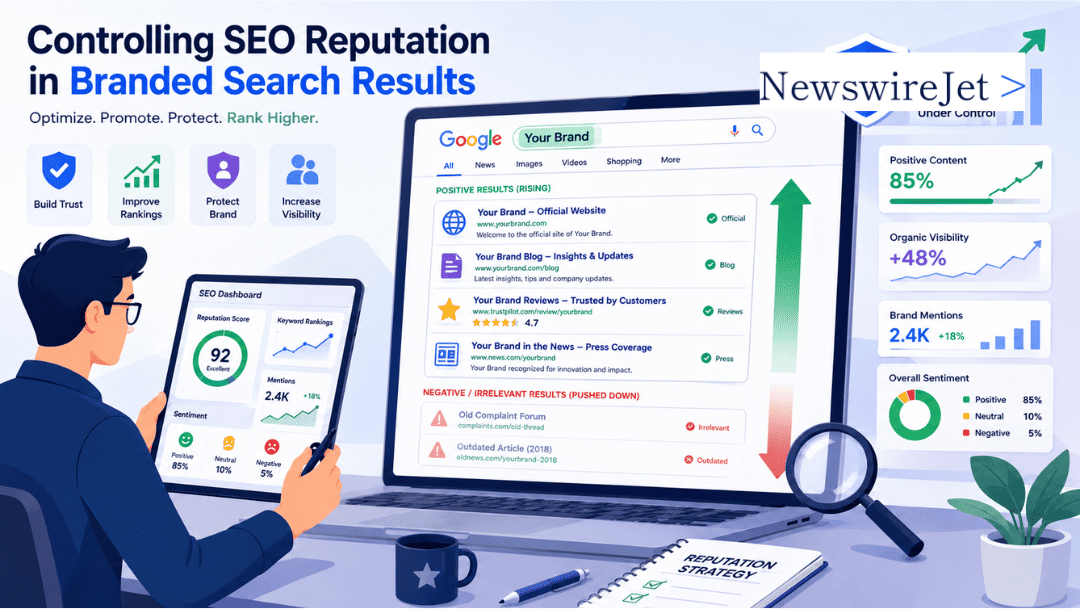
People judge your business by what Google shows them. SEO reputation management is about controlling that. You promote positive content and suppress negative links to protect customer trust and sales.
Most users never look past the first search results page, so what's there is everything. This work spans your website, reviews, social media, and news articles.
It's a practical mix of creating content, using tools to watch what's said about you, and optimizing for search engines. Want to know how to actually do it? The details are below.
Reputation Control in a Nutshell
Together, these actions create a clear framework for protecting and improving how a brand appears in search.
- Controlling SEO reputation means shaping search engine results so positive content dominates branded queries while negative pages lose visibility.
- Strong content creation, review management, and social media optimization help brands control up to 80% of first-page search results.
- Consistent monitoring and ethical SEO tactics strengthen customer trust, brand perception, and online reputation over time.
What Is Controlling SEO Reputation in Online Reputation Management?
When people search for your brand, what they find matters. SEO reputation management is about guiding those results. You use honest SEO practices, create solid content, and polish your official websites and profiles. The aim is to get positive, credible pages to rank higher than any negative ones.
According to Šimunić et al.,
"Search engine optimization, social media activities and consumer-generated content constitute online reputation managements components. ... the loss of reputation in the virtual environment can be instantaneous and the dynamics causing crises in this environment, such as speed, time and space, are boundless." - Journal of Business Research-Turk
Search engines drive public opinion. Research referenced by the Harvard Business Review points out a key fact: around 95% of all clicks go to the first page of search results. This is the reason managing your online reputation is now so closely linked to SEO.
If you control the search rankings for your brand name, you control what customers, journalists, and business partners see first. A strong official blog, active social media, and platforms with good reviews build a believable online image.
If you don't control it, bad reviews, negative news stories, or outdated information can fill up the search page. This shapes how people see your brand and hurts trust.
The main things you need to do:
- Create authoritative, positive pages about your brand.
- Optimize your website and social profiles for searches on your company name.
- Keep track of where your brand is mentioned, especially on review sites.
- Publish better content to push damaging pages down in the rankings.
The goal isn't complicated. You want someone searching for your brand to find the story you're telling.
Why Does the First Page of Search Results Determine Brand Perception?

You don't own your brand's reputation, Google's first page does. Since almost no one clicks to page two, those top ten results are what people believe about you.
Here's the reality: 95% of clicks stop at page one. If a negative article or a customer complaint ranks there, it becomes the first thing anyone sees. A tidy first page looks professional. A cluttered one looks suspicious.
People judge those results in predictable ways. They trust whatever's ranked highest. They read review scores.
They get spooked by a single negative link. And it's not just customers checking; investors and potential employees are searching your name too.
The solution is to fill that page with content you control. Get your official social media accounts, positive press mentions, customer testimonials, and helpful articles to rank.
When someone searches for you, you want them to find your story, not a random complaint. That's how you build a reputation you can actually manage.
How Does SEO Reputation Control Work Strategically?

Think of SEO reputation control like a popularity contest in a crowded room. The loudest, most credible voices get heard first. To manage a bad rumor, you get more trustworthy people to talk positively about you, louder and more often.
According to Research from Paget, as cited in Scholastica,
"Online reputation management (ORM) [is] defined as actively shaping a business's online image... the ability of online reviews to shape perceptions, either positively or negatively, underscores the need for a strategic approach." - Journal of Small Business Strategy
Google and other search engines pick which voices to amplify based on three simple things:
- Authority: Is the source respected?
- Relevance: Does it directly answer the question?
- Freshness: Is the information new?
Reputation management just plays by these rules. You make your positive content more authoritative, more relevant, and more recent. This pushes the negative content down the list.
A solid strategy usually leans on Google's own E-E-A-T concept, Experience, Expertise, Authoritativeness, and Trustworthiness. The process looks something like this:
Start with a Reputation Audit.
You have to know what's being said. Search for your own brand name. Look at the reviews. See exactly where every piece of content, good and bad, currently sits in the search results.
Create a Volume of Positive Content.
One good article isn't enough. You need many. Published across different sites. This increases your visibility and lets you shape the overall narrative.
Strengthen Authority Signals.
This is about getting endorsements. Links from well-known websites and coverage in legitimate news outlets act like public votes of confidence for your content.
Update for Freshness.
Search engines favor the latest news. By consistently adding new information to your positive pages, through updates, new posts, or press releases, you keep them competitive.
Optimize for Entity Recognition.
Help search engines correctly identify your brand and link it to positive sources. Use simple code markup (structured data) and keep your name and details consistent everywhere online.
This turns reputation management into a proactive system. Instead of waiting for a crisis and then reacting, you build a durable, positive presence that can withstand problems.
Which Assets Should Be Built to Control Branded Search Results?
To control what people find when they search for your brand, you need a system. That system is built from pieces you own, your social media pages, your blog, your YouTube channel, your profiles on sites like Yelp or Glassdoor. Each piece is designed to appear in the search results for your company's name.
This works because search engines trust certain platforms more than others. A profile on LinkedIn or a mention in a news article carries weight.
Those pages can rank quickly. By polishing them, you fill up the search page with your own stuff, leaving less room for anything else.
Here’s a list of the pieces used to defend a brand’s reputation online.
| Asset Type | What it Does | How to Make it Work |
| Social media profiles | A trusted page that can rank almost immediately. | Keep the look consistent, post often, and watch what people say. |
| Review platforms | Builds credibility through user ratings and comments. | Ask for reviews from real customers and reply to every one. |
| Blog and company info pages | Steers the conversation and locks down your brand’s keywords. | Link your articles together and make the content useful. |
| Press releases | Gets you links from authoritative news websites. | Spread them through professional PR channels. |
| Microsites | Lets you rank for searches about your reputation or industry. | Focus on specific questions people ask and broader topics. |
| Video platforms | Claims spots in the video results section. | Get the title and thumbnail right, and tell Google the video exists. |
A few places are particularly strong for this. LinkedIn, well-known directories, and trade magazines often show up at the top for a brand search. They stand guard against negative results.
None of this works if the pages are dead. You have to maintain them. Post new content, answer questions, update information. When you do, your brand’s online presence becomes solid. You start to command the search results.
How Should Brands Monitor Their Online Reputation Continuously?

You need to watch what people are saying about you online. If you don't, a minor complaint can quickly become a major story that hurts your business. Finding these problems early lets you fix them before they really stick in people's minds.
You use tools for this. They automatically look for any place your brand is mentioned, checking search trends and the mood of comments on review sites and social media. This gives you a chance to respond before a narrative gets set.
Many companies use platforms like SEMrush specifically to watch their position in search results and track key search terms.
Setting up a monitoring system means doing a few things regularly:
- Brand alerts: A simple tool like Google Alerts sends you an email whenever your company name appears on the web.
- Review monitoring: You check sites like Yelp or Google Reviews. This shows you patterns, if five people this week complained about slow shipping, that's a real issue you need to address.
- Social media listening: Twitter and Facebook show you what's being said right now. This is where a customer's angry post can start to spread.
- Reputation bomb detection: If you suddenly see hundreds of negative mentions in an hour, that's a crisis alarm. It often means someone is targeting you, or a negative story has gone viral.
- Quarterly content audits: Every few months, look at your own website content. Old pages or poorly written articles can lose their search ranking, making your brand harder to find for good reasons.
The entire purpose is to change your posture. Instead of waiting for a crisis to hit, you build a system to see it coming.
What Content Strategies Push Negative Search Results Down?

Target keywords people actually use when looking for you, like "YourBrand reviews" or "YourBrand customer service." Get your own positive pages to rank for those. This works better than trying to get someone else to take down a negative page, especially when a strategy for negative content suppression helps stronger pages gradually replace harmful listings in search results.
Timeline? It's not instant. From what we see in the data, new content usually needs 3 to 6 months to start ranking well. You have to optimize it and get some decent backlinks. Tools like Ahrefs show this pattern all the time.
You need a plan. Write more, and write different things. Build a wall of positive content around your brand name. That means:
- Articles specifically for those branded keyword searches.
- Real stories from customers, with results.
- Useful guides or commentary that makes you look like an expert.
- Actual press releases for real news, to get links.
- Guest posts on other good sites that link back to you.
Doing this also means you might show up in other parts of Google. Like the "People Also Ask" section. Or in voice search answers. Or in those new AI overviews.
It's a slow process, but it works. When enough good, credible content exists about you, the bad stuff just gets buried.
Which SEO Techniques Strengthen Positive Reputation Assets?
Search engines need to be convinced your good pages are the real deal. They look for solid, technical proof. By giving it to them, you help those positive pages show up first, pushing the bad stuff down.
How do you prove it? Here’s what works.
Get Your Titles and Meta Descriptions Right
The page title and that snippet of text in the search results need your brand name in them, but in a way that sounds normal. If it sounds robotic, you’ve gone too far.
Connect Your Good Pages
Link your positive articles, press releases, and profiles to each other. This bundles their authority. It’s like forming a block so they rank as a group, not individually.
Earn Links from Places That Matter
Earn Links from Places That Matter
A link from a local newspaper’s website, a trade association, or a well-known blog is powerful. Strong authority signals also help defend your brand when managing negative SEO tactics to attempt to damage rankings or reputation. It’s a direct signal to Google that other reputable sources vouch for you. This is often the hardest part, but it has the biggest impact.
Add Schema Markup
This is behind-the-scenes code that labels your content for search engines. Telling Google “this is a review” or “this is our business address” can get you those enhanced search results with star ratings or business info. More people click on those.
Refresh Your Content
An article from three years ago looks abandoned. Update the publication date, add a new section, or revise some stats. This tells search engines the page is current and maintained, which is a positive signal.
Doing one thing helps. Doing all of them together builds a much stronger case. Schema makes your listing pop. Fresh content shows you care. Authoritative links build trust.
When you layer on image optimization and a video sitemap, you’re covering all the technical bases. The goal is to make the search engine’s job easy, to clearly show that your pages are the credible, go-to sources.
How Should Brands Respond When Negative Content Appears?
Leaving a bad review unanswered is a mistake. It stays at the top of search results, and everyone sees it. Replying the right way can stop the damage, and consistent response strategies often become part of broader reputation repair SEO efforts that rebuild credibility over time. It shows you're accountable, and a lot of customers will actually change their review after you solve their problem.
Sites like Trustpilot push for fast replies. They treat it as a key metric for trust, and it influences how your business appears in their system.
Here’s a straightforward plan:
- Acknowledge it publicly
Write a short reply on the review platform. Thank the person for the feedback, apologize, and say you’ll help. Stay calm, this reply is mostly for future customers reading the thread. - Take the conversation private
In your public response, direct the customer to your support email or direct messages. Work out the details there, not in the open. - After fixing the issue, ask for an update
If you make things right, it’s reasonable to ask if they’d update their original star rating or comment. Many will, and that can lift your overall score. - Flag reviews that break platform rules
If a review contains abusive language, false claims, or private details, use the platform’s report feature. Platforms often remove these. - Consider legal steps only in extreme cases
If a review is blatantly false and causes real harm, legal removal might be an option. This should be a last resort and usually requires a lawyer. - Never post fake reviews
The Federal Trade Commission prohibits businesses from creating fake feedback or offering incentives for positive reviews. Getting caught can seriously damage your reputation.
Doing this well doesn't just limit the fallout, it makes your business look more honest and reliable to everyone watching.
How Do You Measure Success in SEO Reputation Control?
Credits: Exposure Ninja
You measure SEO reputation success by looking at three things: your search visibility, the overall sentiment about your brand, and the ratio of positive to negative results when people search for you.
Many reputation managers use a specific benchmark. They aim for 80% or more of the first page of Google to be filled with content they control—their website, positive press coverage, or favorable reviews.
Analytics platforms, like Moz, provide the hard data. They show you your keyword rankings and track the growth of backlinks from authoritative sites, which supports these broader goals.
Here are the key performance indicators you’ll typically monitor:
- First page sentiment
The overall tone of the results on page one. Are the top links praising your brand or criticizing it? - Positive vs. negative result count
A simple count of how many search results portray your brand positively versus unfavorably. - Branded keyword rankings
When someone searches your exact brand name on Google, check where your official website appears in the results. - Visibility of owned content
Determine whether your own assets, such as your blog, press releases, or case studies, are appearing for brand-related searches. - Growth of quality backlinks
Track whether more reputable websites are linking to your positive content over time. - Review metrics
Monitor the trend of your average star rating and the number of new reviews being added. - SERP reports for all devices
Check which pages appear not only on desktop results but also on mobile and voice search results.
Research published by the Harvard Business Review has shown a clear link. The visibility of a positive reputation in search results strongly correlates with customer trust and their final purchase decisions.
Measuring these points consistently allows you to refine your strategy and maintain control over how your brand appears online.
FAQ
How can SEO reputation management improve online reputation and public perception?
SEO reputation management improves online reputation by shaping what people see in search results. Businesses publish helpful content, encourage positive customer reviews, and maintain accurate information across platforms.
These actions strengthen public perception and highlight trustworthy pages. Over time, positive assets such as articles, press releases, and social media profiles can outrank negative content and improve a brand's reputation.
What steps help reduce negative search results about a brand name?
Reducing negative search results requires a consistent strategy. Businesses create optimized content, publish press releases, and strengthen social profiles so they rank for branded keywords. Companies should also respond to negative feedback with clear customer service.
As stronger pages gain authority and backlinks, they improve search engine rankings and gradually push negative content lower in search results.
How do online reviews and review sites affect brand perception?
Online reviews strongly influence brand perception because many customers read them before making decisions. A large number of positive customer reviews builds customer trust and improves a company’s reputation.
Review sites also appear prominently in search engine results. When businesses respond to negative reviews politely and resolve issues, they demonstrate accountability and strengthen their online reputation.
Why are social media profiles important for SEO reputation management?
Social media profiles often rank for branded keywords in search engine results. Active social media accounts create additional positive pages that appear when people search for a brand name.
Regular posting, social media monitoring, and professional responses to feedback help control brand mentions. These actions strengthen digital presence and support a stronger SEO reputation.
Which tools help monitor search engine results and online brand reputation?
Several tools help businesses monitor search results and manage online brand reputation. Google Alerts can notify teams when new brand mentions appear online. Google Search Console provides data about search engine rankings and organic traffic.
Reputation management software and review analytics tools help track review volume, identify negative feedback, and monitor changes in search engine results.
Take Control of Your Search Reputation
You check your brand on Google and see outdated posts or weak mentions sitting above the story you actually want people to see, it makes your stomach drop because you know customers are judging you in seconds. It’s frustrating.
Reputation SEO only works when positive signals keep showing up, when strong content and credible media coverage slowly push the right narrative to the top.
A practical shortcut is using distribution that puts your story on trusted media sites, which helps search engines see stronger authority around your brand.
Publishing news through NewswireJet can help you place positive brand stories across recognized outlets, making it easier for the search results to reflect the reputation you want people to find.
Related Articles
References
- https://dergipark.org.tr/en/download/article-file/1843454
- https://jsbs.scholasticahq.com/article/151294-from-reviews-to-revenue-examining-the-impact-of-online-reputation-management-on-small-business-performance