
Written by David Quintero
Your latest campaign got mentioned in a blog and shared a bunch of times. That's good, right? But try putting a number on it for the quarterly report.
That's where Earned Media Value, or EMV, comes in. It's basically a way to slap a dollar amount on all that free publicity,every article, tweet, or influencer video you didn't pay to place.
Teams use it to show the financial impact of their work and defend their budgets. There's no one right way to calculate it, and the final number can tell a very selective story.
Want to know more? Keep going.
EMV Essentials: What Every Marketer Should Remember:
EMV helps quantify brand exposure,but only delivers real insight when used consistently and alongside other performance metrics.
- Turns Visibility Into Dollar Value – Assigns financial worth to unpaid media and influencer coverage.
- No Standard Formula – Methods vary, so consistent calculation is key.
- Not a Standalone Metric – Pair with engagement, traffic, and conversions for full impact.
What Is Earned Media Value (EMV)?
Earned Media Value is how companies try to put a price tag on free press. It's not an exact science, but it's the go-to method for estimating the worth of an influencer's post, a news story, or any online buzz you didn't pay for directly.
You can't buy this kind of coverage, not really. It has to be earned. That happens when people actually like your product, or when a PR campaign hits the right note.
For marketing and PR folks, EMV is their report card. It translates public interest into a number the finance department can understand.
The core question is straightforward: if we wanted to buy this same level of attention, what's the invoice?
Let's say a tech reviewer with a million followers praises your new gadget. EMV would take that post, look at its reach and engagement, and compare it to the cost of a paid ad with similar metrics.
The resulting figure is your Earned Media Value.
The Difference Between Earned, Owned, and Paid Media
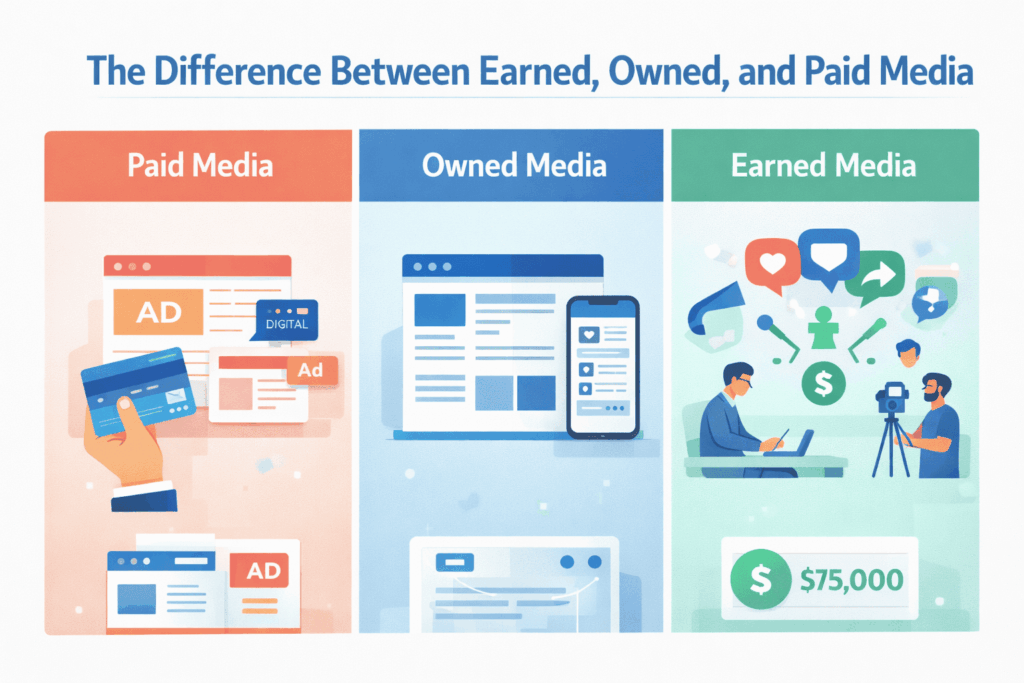
Paid media is easy to understand. You write a check, you get an ad. Google Ads, Facebook promotions, sponsoring a podcast, it's all transactional. You control the message, but everyone knows it's an advertisement.
Owned media is what you build yourself. Your website. Your blog. Your official Instagram feed. These are your assets, your direct line to customers.
Earned media is the wild card. You don't pay for it, and you don't control it. It's a journalist choosing to write about your launch.
It's a customer posting an unboxing video that gets a million views. It's Reddit users debating your product. This stuff carries weight because it's independent.
EMV exists because earned media is powerful but messy. How do you prove the value of a trending tweet or a positive news article to someone who only looks at spreadsheets? EMV is the attempt to answer that.
It slaps a dollar amount on organic buzz, trying to translate public perception into a language that stakeholders, who often just want to see the numbers, will accept.
Why EMV Matters for Brands and Marketers
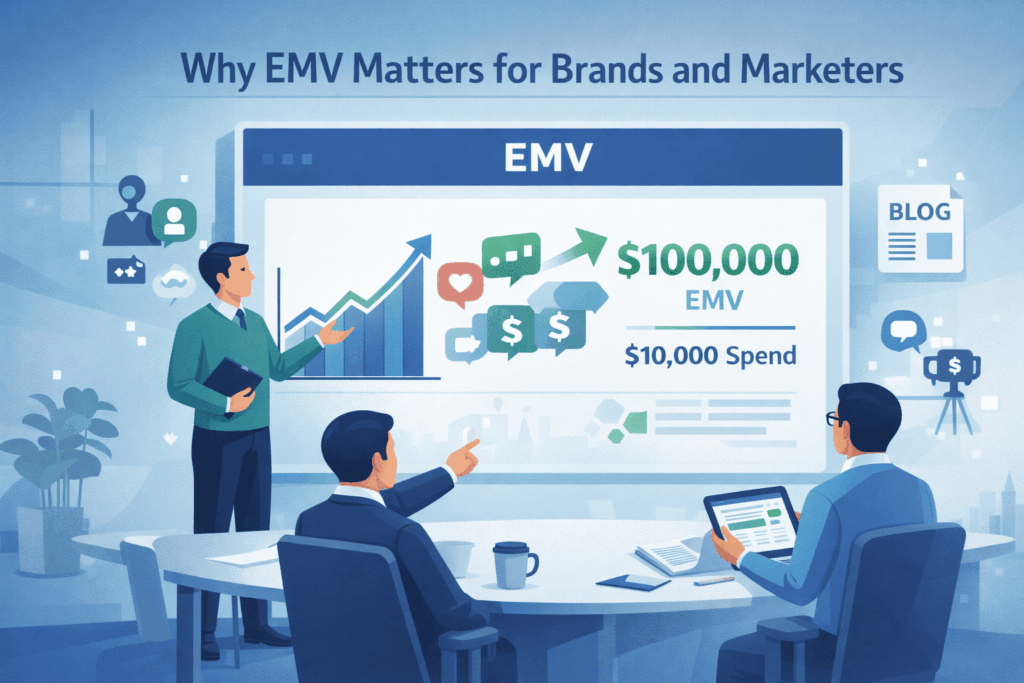
Marketing budgets are getting squeezed, and everyone’s being asked to prove what they’re bringing to the table.
For PR and influencer folks, that’s always been a tough sell. How do you put a number on a relationship or a press hit?
That’s the whole point of Earned Media Value, or EMV. It’s not a perfect science, but it gives you a fighting chance. Let’s say you get a feature in Forbes. Cool.
But in the budget meeting, “cool” doesn’t cut it. With EMV, you can walk in and say, “That one article? We calculated it’s worth about fifty grand in equivalent ad space.” Now you’re speaking their language.
This is how you keep your budget from getting axed. You show that the $10k you spent on that influencer didn’t just buy some nice photos, it generated an estimated $100k in value.
You’re not asking for money for “brand building” anymore; you’re showing a return on investment.
And honestly, the best use of EMV isn’t for bragging about last quarter. It’s for figuring out where to put your money next time.
If your TikTok creators are consistently showing three times the EMV of your trade press releases, that’s a signal you can’t ignore.
It tells you to stop throwing good money after bad and double down on what actually moves the needle.
Common Methods for Calculating EMV
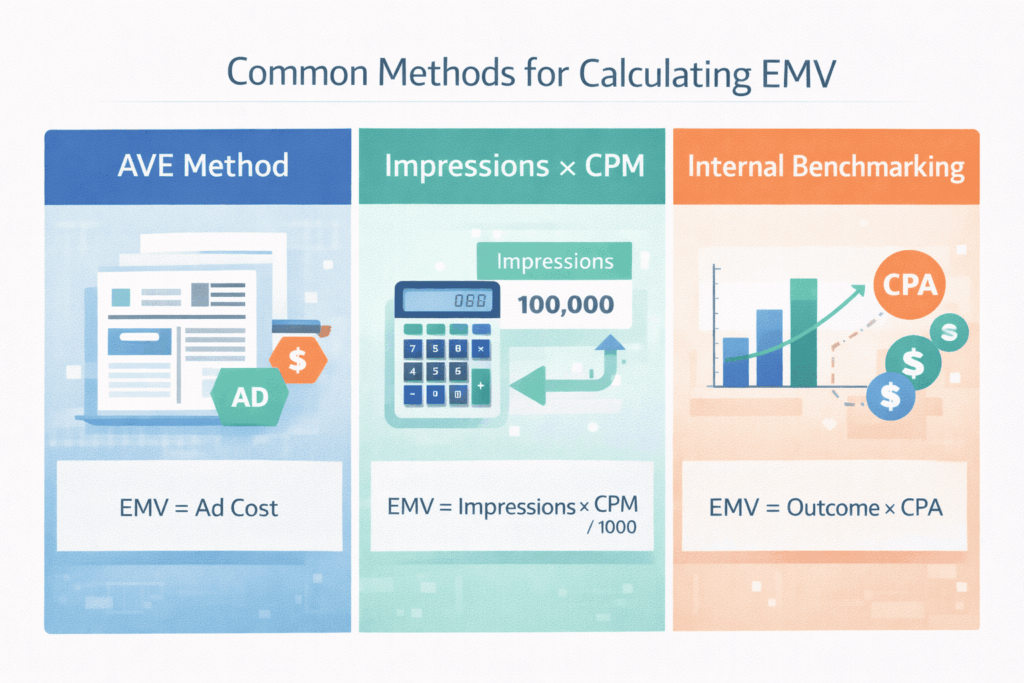
Calculating EMV is frustrating because there's no right answer. The number you get depends entirely on the method you pick, and every method has a major flaw.
Method 1: The AVE (It's Bad, But People Use It)
This is the simplest way. You see a news article about your company. You look up what a display ad of the same size in that publication costs. That price tag becomes your EMV, essentially the foundation behind calculating PR value through AVE.
Sometimes that number gets multiplied. A manager might decide that editorial coverage has 3x the value of an ad, so they triple it.
According to Influencer Hero,
"Calculating EMV involves assigning a monetary value to the organic exposure your brand receives... The best way to determine a CPM to calculate your EMV is to take the equivalent rate you would pay using paid ads and adding a premium / markup of around 50% - 100%. The reason we recommend adding a markup is because not all impressions are equal." - Influencer Hero
The criticism here is total. This method gives the same dollar value to a devastating investigative piece and a glowing product review.
It ignores sentiment, audience, and impact. Professional bodies have told the industry to abandon AVE for years. It survives because it's easy, not because it's good.
Method 2: For Influencers (Impressions x CPM)
You're usually dealing with a social media post, especially when calculating earned media value in influencer marketing campaigns. The standard math is:
Take the total number of impressions (views). Divide by 1,000. Multiply by the average cost to reach a thousand people on that platform (the CPM).
Example: A tweet gets 100,000 impressions. X/Twitter average CPM ~$8-12.
The problem? You're using an advertising metric to value what's supposed to be organic word-of-mouth. A paid ad and a creator's authentic post are not the same thing, but this formula treats them identically.
Method 3: Benchmarking to Your Own Costs
This approach tries to be more practical. You use your own marketing performance as a ruler.
If you know it costs you $30 to acquire a customer via Facebook ads, and a podcast feature drives 50 new customers, you could assign an EMV of $1,500.
This ties the value to a real business outcome you understand. But it's narrow. It only captures direct, trackable actions like a sale or a sign-up.
It completely misses the value of brand awareness or credibility built by a major magazine feature, which is often the main point of PR.
So you choose your flaw: an oversimplified number (AVE), a number that misunderstands the medium (Influencer CPM), or a number that's too narrow (Internal Benchmark).
Step-by- Step Guide to Calculating EMV
There's no magic formula for EMV. Anyone who says there is is selling something. You're basically trying to put a dollar value on buzz you didn't pay for, which is inherently fuzzy.
But you still need a number, so here's how to build one that doesn't fall apart, whether you're building your own model or using an earned media value calculator to standardize the math.
1. Round up all your free press.
You need a list. Scour the internet for every single time your brand shows up without an invoice attached.
- That blog post from an industry writer.
- The TikTok from a creator who just loves your product.
- All the tweets and Instagram stories where people tagged you.
- That podcast episode where the host mentioned you.
Use Google Alerts. If you have the budget, use a tool like Meltwater. The goal is to miss nothing.
2. Play "what if" with ad budgets.
For each item on your list, pretend you bought that exact spot as an ad. What's the price tag?
- Example: A news site article got 200,000 views. You know a banner ad on that site has a $50 CPM. Your calculation: (200,000 / 1000) * $50 = $10,000.
- Example: A YouTube review got 50,000 views and 2,000 likes. You decide a view is worth $0.03 and a like is $0.15. That's ($1,500 + $300) = $1,800.
The most honest numbers come from your own ad spend. What did you actually pay for a thousand views on a similar site last quarter? Use that.
3. Impressions are cheap. Engagement is the real currency.
A post seen by a million people who scroll past is worthless. A post seen by 10,000 that gets saved, shared, and discussed has real value.
You must factor this in. So your formula gets a second part. It might look like this: EMV = (Impressions × Your Actual CPM / 1000) + (Likes + Comments + Shares × Your Assigned Dollar Value)
4. Apply the "So What?" test.
A rave review in Wired is not the same as a bland listing in a generic newsletter. You have to grade the quality.
- Tone: Was it love, or just acknowledgement?
- Focus: Were you the star, or a side character?
- Audience: Did it reach people who might actually buy your thing?
This is subjective. Assign a score. Amazing, relevant coverage? Multiply its value by 1.5. A passing, mediocre mention?
According to Forbes,
"We developed a system to calculate what we call the 'engagement value' for every earned media placement. The formula is: placement quality score x estimated audience = engagement value... This approach helps us calculate a more accurate estimated audience for each individual placement. Leveraging The Engagement Value... has been able to demonstrate the value of PR efforts." - Forbes
Maybe multiply by 0.5. This final adjustment is where your judgment turns data into a useful metric.
Tools and Platforms That Help Calculate EMV
Manually calculating EMV is a slog. Doing it across multiple campaigns? That's a fast track to burnout. The process is repetitive, and it's easy to make small errors that throw off your whole report.
You need a system. Luckily, the tools fall into a few clear categories.
Category 1: The PR Workhorses (Cision, Meltwater, CoverageBook)
Think of these as your automated clipping service and analyst rolled into one. They constantly scan for your brand name across news sites, magazines, TV transcripts,pretty much everywhere.
Every time you get a mention, they log it, guess how many people saw it, and assign a dollar value (usually based on old-school AVE models). The bonus is they often tag the sentiment (positive, negative, neutral) and give you a rough sketch of the audience.
If your job is to report on media coverage volume, these tools are essential.
Category 2: The Influencer Calculators (Traackr, CreatorIQ, Upfluence)
PR platforms often stumble with influencers. These tools are built for it. They don't just look at an influencer's follower count; they analyze how their audience actually engages,likes, comments, shares.
They then calculate an EMV based on what it would cost to get that same engagement through paid ads on Instagram, TikTok, or YouTube.
The output lets you directly compare the performance of Creator A versus Creator B, which is invaluable for planning your next campaign.
Category 3: The Custom Spreadsheet
Sometimes, the pre-built tools don't match how your company measures things. Their formulas might be a black box.
That's when you build your own. Open Google Sheets or Excel and create your own calculator. A basic framework looks like this:
= (Impressions / 1000) * [What you pay for 1,000 ad impressions] + (Total Engagements) * [What you think one engagement is worth]
You define the values in the brackets. This forces you to decide: what is our actual CPM? What's a 'like' really worth to us?
The model is completely transparent and adapts as your strategy changes. The downside, of course, is you have to build and maintain it.
EMV Example: When It Works, and WHen It Doesn’t
GlowUp Skincare: The micro-influencer play
GlowUp is a small beauty company. They launched a new serum. No big ad budget. They picked 10 micro-influencers, each with around 50k followers, and sent them free products. The agreement was one Instagram post and two Stories per person. Payment was the product itself.
Here's what came back:
- Influencers: 10
- Potential impressions: 500,000
- Engagement rate: 4%
- Total engagements: 20,000
- Total spend: $2,000 (product, packaging, shipping)
Calculating the value
We used typical rates: $25 per 1,000 impressions and $0.10 per engagement.
- Impression Value: (500,000 / 1,000) * $25 = $12,500
- Engagement Value: 20,000 * $0.10 = $2,000
- Total EMV: $14,500
The outcome
They spent $2,000. The earned media was worth $14,500. That's a 625% return.
It worked. The influencers were the right fit,their followers cared about skincare. The content felt real, not like an ad. Low cost, high visibility.
RunTribe: The paid promotion flop
RunTribe, a new shoe brand, took the opposite approach. They paid a fitness influencer with 200,000 followers. The deal was for one YouTube video and two Instagram posts.
The video looked professional. The response was flat.
The numbers:
- Influencer: 1
- Total reach: 150,000 (combined)
- Engagement rate: 1.5%
- Total engagements: 2,250
- Total spend: $10,000 ($8,000 fee + $2,000 product/shipping)
Running the numbers
Same idea, different rates: $20 CPM and $0.08 per engagement.
- Impression Value: (150,000 / 1,000) * $20 = $3,000
- Engagement Value: 2,250 * $0.08 = $180
- Total EMV: $3,180
What went wrong
They spent $10,000. The EMV was $3,180. The return was only 31.8%.
The audience wasn't invested. The review sounded scripted. There was no offer or clear call to action. They paid for a big name, but not for real influence.
Putting them side by side
Metric
GlowUp Skincare
RunTribe Footwear
Spend
$2,000
$10,000
Impressions
500,000
150,000
Engagements
20,000
2,250
CPM Used
$25
$20
Engagement Value
$0.10
$0.08
Total EMV
$14,500
$3,180
ROI
625%
31.8%
The difference is stark. One campaign understood its audience. The other just wrote a check.
Before you launch, do the math. Estimate your impressions and engagements, apply those standard rates, and see what the EMV forecast looks like.
After the campaign, compare your forecast to the real result. That's how you figure out what's actually working.
Limitations and Criticisms of EMV
It’s that number you get when you try to put a dollar value on your earned media,press hits, social mentions, that kind of thing. On paper, it seems great. In practice, it’s tricky.
A lot of people in PR aren’t fans. They’ve argued for years that EMV can be misleading.
It often oversimplifies the impact of a news story or a social post, turning something complex into a single, sometimes shaky, figure.
Why the number can be too high
The main issue? EMV can inflate your results. It usually works by taking the ad space your coverage would have cost (that’s AVE) or by counting estimated impressions. Both methods have problems.
Take a press release sent over a wire service. It gets picked up by hundreds of small sites automatically.
Your report shows thousands of impressions. But were those articles read? Did they engage anyone? Probably not. The “value” is mostly theoretical.
Then there are multipliers. Some models multiply the AVE by 2 or 3, arguing that earned media is more credible than an ad.
If you’re not extremely careful about how and when you apply that multiplier, you end up with a number that’s disconnected from reality.
It doesn’t understand context
EMV is famously tone-deaf. A major newspaper might run a story criticizing your company. You still get a high EMV because of the outlet’s prestige and reach.
The metric treats that negative coverage the same as a glowing review. Without layering in sentiment analysis, you’re missing a huge part of the story.
It also misses relevance. Imagine a B2B industrial software company getting a plug in a popular fashion blog.
The EMV might look good on a spreadsheet. But the readers of that blog aren’t buying factory floor management systems. The exposure is worthless.
You can’t use it alone
This is the big one. EMV tells you nothing about what actually happens after people see your coverage. Did they visit your site? Did their opinion of your brand change? Did they buy anything?
An influencer might create a viral video about your product. The EMV could be enormous.
But if the video drives a million clicks from people who will never become customers, the business value is zero.
You have to mix EMV with other metrics to get the real picture. Things like:
- How much website traffic came directly from that press coverage?
- What were the engagement rates on social shares?
- Did you use trackable links or promo codes to see if it led to sales?
- Is your overall share of voice in the industry changing?
- What is the sentiment around your brand over time?
EMV is just one data point. It’s useful for showing rough scale and justifying PR spend in budget meetings.
But if it’s the only number you’re looking at, you’re not seeing the whole story.
How to Get EMV Right, Best Practices
Credits: Ainfluencer Marketplace
EMV is messy. Everyone knows it. The number itself can be kind of a fantasy.
But clients ask for it, bosses expect it, and sometimes you just need a dollar figure to put in a slide. So you use it, but you build guardrails around it.
Lock down your formula.
Choose one way to do the math and don't change it mid-stream. AVE, CPM, engagement rate, pick your poison and stick with it for the entire campaign, and the next one likes it.
Write the formula down in plain English and share it with anyone who sees the final report.
This isn't about perfection; it's about avoiding arguments later. If you're using a custom benchmark, like your own historical CPM, update it quarterly. An outdated benchmark makes the whole exercise pointless.
The dollar amount is useless by itself.
A $250,000 EMV value could be a disaster or a home run. You have to annotate it.
- Was the coverage a full interview or a two-sentence blurb?
- Did the influencer actually use the product, or did they just post the stock photo you sent?
- Was the article buried, or was it the main story?
This commentary is what your stakeholders are actually buying. The EMV is just the header.
Bend the metric to your goal.
Using the same EMV calculation for an awareness campaign and a product launch is like using a hammer to screw in a lightbulb.
- Awareness: Go with CPM. You're counting impressions.
- Influencer Collab: Bake in engagement metrics. A like on Instagram doesn't cost the same as a like on Facebook. Use platform rates.
- Earned Media: Score the quality. Was the sentiment positive? Was your brand in the headline or the boilerplate at the end? Did the Wall Street Journal pick it up, or was it a niche blog?
When the calculation reflects what you were actually trying to do, the report might tell you something you didn't already know.
FAQ
How do I calculate Earned Media Value for my campaign?
To calculate Earned Media Value, you need to track all media mentions, social media posts, influencer mentions, and user-generated content related to your campaign.
Then compare the total organic impressions and engagement actions to current paid media rates, often using cost per thousand impressions as a benchmark.
This process helps you assign a realistic dollar value to your media coverage using accurate media analytics and social listening tools.
What factors influence Earned Media Value results?
Several market-specific variables directly influence Earned Media Value. These include content volume, content format, social shares, brand sentiment, and positive reviews.
Your influencer marketing strategy, influencer partnerships, and public relations efforts also affect performance.
In addition, your market share, SEO ranking, and overall audience engagement across social networks determine how much media value your campaign generates.
How is Earned Media Value different from paid advertising metrics?
Earned Media Value measures the impact of organic impressions generated through media coverage, influencer mentions, and user-generated content.
Paid advertising metrics measure performance from paid media using paid media rates and direct spending data.
Unlike Advertising Value Equivalent, modern EMV includes engagement actions, social analytics, and brand sentiment. This approach provides a clearer view of potential revenue impact compared to paid media alone.
Can social media influencers increase Earned Media Value?
Social media influencers can significantly increase Earned Media Value when they create authentic social media content that resonates with their audience.
Influencer marketing and creator marketing encourage social shares, social posts, and website clicks.
A well-planned influencer marketing strategy within the creator economy strengthens audience engagement and improves brand sentiment across every major social platform.
Which metrics should I track to improve Earned Media Value?
You should track media mentions, PR clippings, social media content performance, and engagement actions to improve Earned Media Value.
Monitoring Share of Voice, audience engagement, website clicks, and brand sentiment provides clear performance insight.
Social listening tools and media analytics help measure digital media reach, organic impressions, and the overall media impact value generated by your media outreach and PR campaigns.
Make EMV Prove Its Worth
You're watching mentions roll in and wondering if that EMV number really means progress. It looks impressive on paper, but it doesn't prove growth.
NewswireJet gives you a simple way to turn coverage into measurable action that supports real business goals. If you're ready to make EMV work, start here
References
- https://www.influencer-hero.com/blog-detail/how-to-calculate-earned-media-value-in-influencer-marketing
- https://www.forbes.com/councils/forbescommunicationscouncil/2019/04/03/how-to-measure-the-engagement-value-of-earned-media/
Related Articles